






The Big Picture: Why AI Adoption Is Accelerating
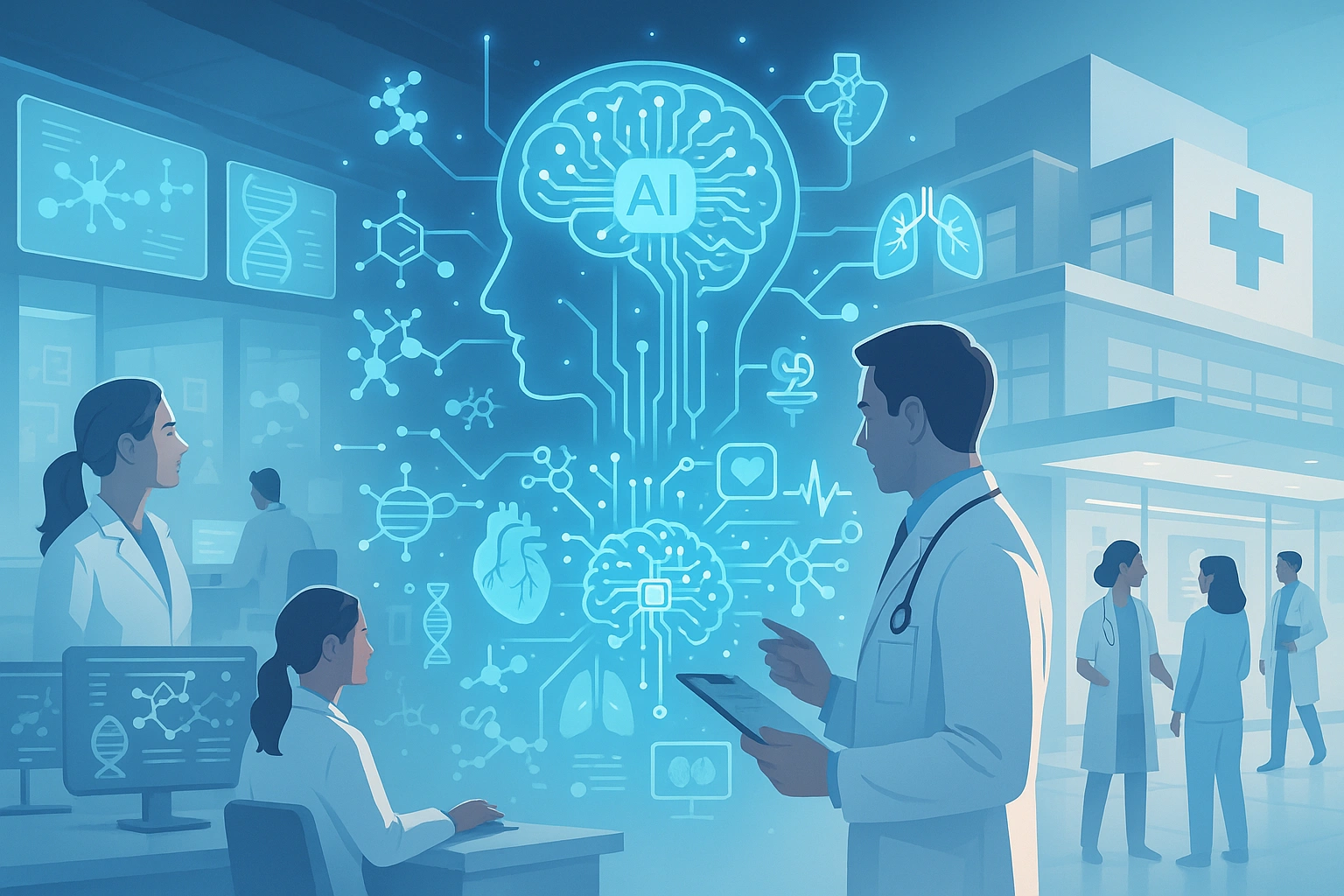
Artificial intelligence has crossed a critical threshold in healthcare. What once existed as experimental prototypes has matured into clinically deployed systems influencing patient outcomes.
The convergence of foundation models, large-scale medical datasets, and improved regulatory clarity has dramatically shortened the path from research to bedside. Hospitals, pharmaceutical companies, and startups alike are moving beyond pilots and embedding AI directly into operational and clinical decision-making.
Key Forces Driving Acceleration
- Breakthroughs in generative and multimodal AI models
- Digitization of health records, imaging, and genomics
- Clearer regulatory pathways for AI-based medical software
- Economic pressure to reduce clinician burnout and operational costs
Why AI Is Moving Faster From Labs to Clinics
Healthcare innovation traditionally moved slowly due to safety concerns and regulatory rigor. AI has changed that equation.
Model Capability Improvements
Modern AI models can analyze text, images, signals, and molecular structures within a single system. This eliminates years of fragmented development across separate tools.
Data Availability and Infrastructure
Electronic health records, medical imaging archives, genomic databases, and wearable devices now generate unprecedented volumes of data, fueling continuous model improvement.
Regulatory Evolution
Regulators such as the FDA are shifting toward lifecycle-based oversight, allowing AI systems to evolve while maintaining patient safety.
Computational Biology and Protein Modeling
The AlphaFold Effect
Protein structure prediction was a decades-old bottleneck in biology. AI models like AlphaFold have effectively removed this barrier by predicting protein structures with near-experimental accuracy.
Clinical and Research Impact
- Faster drug target validation
- Improved antibody and vaccine design
- Reduced dependency on expensive wet-lab experiments
AI-driven molecular design shortens early-stage drug discovery timelines and significantly lowers research costs.
AI in Medical Imaging and Diagnostics
Radiology and Pathology Transformation
Deep learning models now assist clinicians by detecting tumors, strokes, fractures, and retinal diseases with high sensitivity.
Clinical Benefits
- Faster diagnosis in emergency settings
- Reduced radiologist workload
- Improved access in underserved regions
Important Caveat
Performance varies across populations and devices, making continuous monitoring essential.
Large Language Models in Clinical Workflows
Reducing Administrative Burden
LLMs automate clinical documentation, discharge summaries, and prior authorization letters, allowing clinicians to focus on patient care.
Decision Support, Not Decision Making
When paired with medical knowledge bases, LLMs assist in differential diagnosis and guideline adherence while keeping clinicians firmly in control.
Human-in-the-Loop Is Mandatory
LLMs can hallucinate. Clinical deployment requires human verification, audit trails, and strict governance.
AI in Clinical Trials and Drug Development
Smarter Trial Design
AI optimizes patient selection, site recruitment, and trial protocols, reducing delays and costs.
Synthetic Control Arms
Virtual patient cohorts reduce trial size requirements while maintaining statistical rigor.
Regulation, Validation, and Patient Safety
Lifecycle-Based Regulation
Regulators now expect continuous performance monitoring, version control, and risk mitigation plans for AI systems.
Clinical Validation
Prospective trials and real-world evidence are essential to prove that AI improves outcomes—not just accuracy metrics.
Bias, Equity, and Ethical AI in Medicine
AI systems trained on biased data can worsen healthcare disparities. Equity-first AI design is now a clinical and ethical requirement.
Mitigation Strategies
- Diverse and representative datasets
- Performance reporting by demographic group
- Transparent model documentation
Healthcare AI Business Models
Common Monetization Approaches
- Software-as-a-Medical-Device subscriptions
- Workflow automation platforms
- Outcome-based reimbursement models
Real-World Case Studies
AI-Accelerated Drug Discovery
Biotech firms are using protein modeling to reduce early-stage failure rates and speed up candidate selection.
AI Triage in Emergency Care
Stroke detection algorithms now flag critical scans within minutes, improving response times.
Clinical Documentation Automation
Health systems report reduced burnout and improved coding accuracy with AI-assisted documentation.
Technical Patterns for Clinical Deployment
- Human-in-the-loop oversight
- Continuous model monitoring and retraining
- Privacy-preserving data architectures
- Explainable AI and audit logs
Metrics That Matter Beyond Accuracy
- Time to diagnosis
- Clinical outcomes
- Operational efficiency
- Equity and fairness metrics
- Return on investment
The Future of AI in Medical Science
Over the next few years, healthcare will adopt modular AI ecosystems, domain-specific foundation models, and stronger regulatory frameworks. Organizations that balance innovation with responsibility will lead the transformation.
AI is no longer optional in medicine. The real question is how responsibly and effectively it will be deployed.
Frequently Asked Questions
How is AI used in medical science today?
AI is used in diagnostics, drug discovery, clinical documentation, medical imaging, and patient monitoring.
Is AI safe for clinical use?
Yes, when deployed with regulatory approval, human oversight, and continuous monitoring.
Can AI replace doctors?
No. AI augments clinicians by improving efficiency and accuracy, but medical decisions remain human-led.
What are the risks of AI in healthcare?
Bias, data privacy, and over-reliance are risks that require strong governance and ethical design.


