







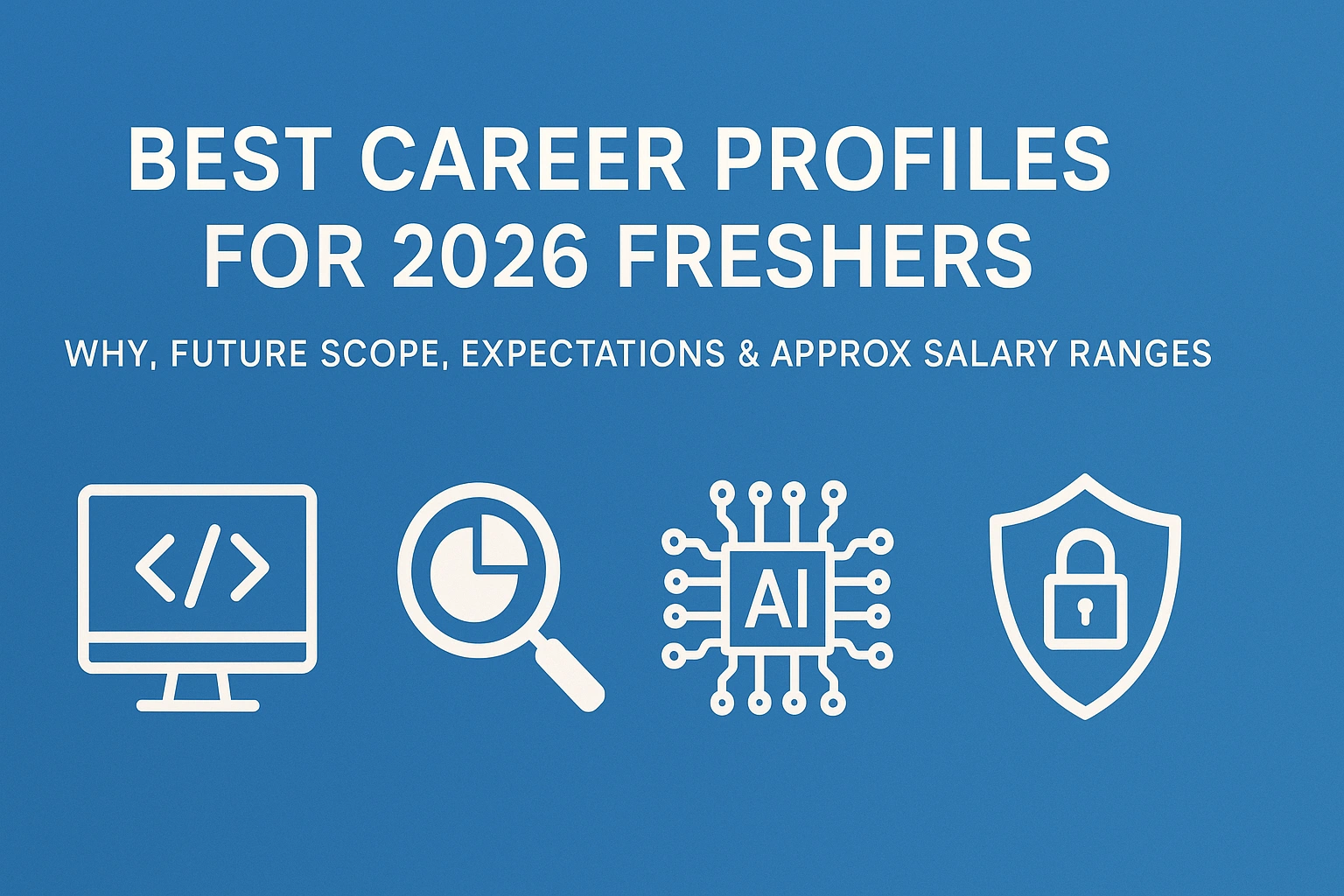
If you graduate in 2026, choosing the right career path means balancing current demand, future resilience, and personal fit. This guide walks through the top career profiles freshers should consider, why each role is strong, the skills you need, expected day-to-day work, prospects, and approximate global salary ranges for entry-level hires.
Overview — Why these careers for 2026 freshers?
Graduating into the 2026 job market means competing in a world where automation and AI tools accelerate productivity while also creating new product categories and demand for specialized skills. The strongest career bets sit at intersections: technology + data + security + product + automation. This guide covers ten profiles that combine present demand, near-term growth, and clear learning paths for freshers.
For each profile below, you’ll find: what the role is, why it’s attractive for 2026, day-to-day expectations, future scope, skills required, and approximate global entry-level salary ranges. Use this to shortlist roles based on your interests and craft a 3–6 month learning plan.
1. Software Engineer / Full-Stack Developer
What this role is about
Software engineers design, build, and maintain applications and services. A full-stack developer works across front-end (user interfaces) and back-end (APIs, databases, business logic). Expect to write code, fix bugs, implement features, collaborate in cross-functional teams, and participate in code reviews.


Why this is a top choice for 2026 freshers
- High & steady demand: software drives digital products across every industry.
- Clear entry paths: learn HTML/CSS/JavaScript, one front-end framework, one back-end stack, and Git.
- Remote opportunities: well-suited to global and remote hiring.
- Career mobility: move into SRE, DevOps, data roles, product, or engineering management.
Day-to-day expectations
Feature implementation, debugging, writing tests, code reviews, attending standups, and collaborating with product and design teams. Familiarity with Agile workflows and Git is expected.
Skills & tools to learn
HTML/CSS, JavaScript (ES6+), React/Angular/Vue, Node.js/Python/Java backend, REST APIs, databases (SQL/NoSQL), Git, basic cloud (AWS/GCP/Azure).
Future scope (2026–2035)
AI tools will accelerate development, but engineers who understand architecture, reliability, security, and integration will be essential. Expect new roles around AI platform engineering, edge computing, AR/VR apps, and domain-specific engineering.
Approx global salary range — entry level (approximate)
- United States: ~$75,000–$100,000 / year
- Western Europe: ~€40,000–€55,000 / year
- UK: ~£30,000–£45,000 / year
- India: ~₹4–10 LPA (varies widely by company)
2. Data Analyst — Pathway to Data Scientist
What this role is about
Data analysts transform raw data into actionable insights using SQL, spreadsheets, and visualization tools. They build dashboards, analyze funnels, and answer business questions for marketing, product, and ops teams.


Why this is a smart choice
- Ubiquitous need: organizations need analysts to make data-driven decisions.
- Accessible entry: non-CS grads can start with SQL, Excel, and a BI tool.
- Career ladder: analyst → data scientist/analytics engineer/product analyst.
Skills & tools
SQL, Excel/Google Sheets, Python (Pandas), Power BI/Tableau/Looker, basic statistics, data cleaning, and storytelling with data.
Future scope
Specializations (marketing analyst, growth analytics, product analytics) will grow. Analysts will also need to work with AI-enhanced BI tools, but they remain crucial for framing business questions and validating data quality.
Approx salary range — entry level
- United States: ~$55,000–$75,000 / year
- Western Europe / UK: ~€35,000–€50,000 / year / £28,000–£40,000
- India: ~₹3.5–6 LPA
3. AI / Machine Learning Engineer
What this role is about
ML/AI engineers design, train, and deploy machine learning models and ML pipelines. Work ranges from classical ML to modern large language models (LLMs), computer vision, and production model monitoring.


Why this is a high-value career for 2026
- Strategic priority: AI/ML is central to product roadmaps across industries.
- High compensation: entry and senior roles often attract premium pay.
- Wide applications: recommendation engines, NLP products, vision systems, and more.
Skills & tools
Mathematics & statistics, Python, scikit-learn, TensorFlow/PyTorch, data engineering basics, model evaluation, MLOps fundamentals, and an understanding of bias & safety.
Future scope
Expect rapid growth. Roles will split into applied ML engineers (product-focused), ML platform engineers (MLOps), and specialists focusing on safe & compliant AI.
Approx salary range — entry level
- United States: ~$100,000–$140,000 / year (varies by company and specialization)
- Western Europe / UK: ~€45,000–€65,000 / year / £40,000–£60,000
- India: ~₹6–20 LPA (wide spread depending on company)
4. Cybersecurity Analyst / Engineer
What this role is about
Cybersecurity professionals protect systems and data against threats. Entry roles include SOC analyst, incident responder, and security operations roles. Responsibilities include monitoring logs, responding to incidents, and applying security controls.


Why consider cybersecurity in 2026
- Growing threat landscape: attacks are more frequent and costly.
- Budget priority: companies invest heavily in defensive talent.
- Specialization opportunities: cloud security, app security, AI security.
Skills & tools
Networking basics, OS internals (Linux/Windows), SIEM tools, vulnerability scanning, incident response, secure coding awareness, and cloud security fundamentals.
Future scope
As cloud adoption, IoT, and AI expand, security roles will become more central and specialized. Security experience often leads to high-responsibility roles and strong compensation over time.
Approx salary range — entry level
- United States: ~$70,000–$100,000 / year
- Western Europe / UK: ~€40,000–€55,000 / year / £32,000–£50,000
- India: ~₹3–8 LPA (varies by employer)
5. Cloud Engineer / DevOps Engineer
What this role is about
Cloud and DevOps roles focus on automating deployments, ensuring reliability, and managing cloud infrastructure. They build CI/CD pipelines, monitor systems, and optimize costs and performance.


Why this is a strong pick
- Cloud-first world: most organizations run workloads in the cloud.
- High leverage: automation improves productivity across teams.
- Job growth: SRE and platform engineering are increasingly common.
Skills & tools
AWS/Azure/GCP fundamentals, containerization (Docker), orchestration (Kubernetes), Terraform/CloudFormation (IaC), monitoring (Prometheus/Grafana), CI/CD (GitHub Actions/Jenkins), and scripting.
Future scope
Expect growth in platform engineering, multi-cloud orchestration, and cloud security roles. Automation and developer platform work will become central to engineering teams.
Approx salary range — entry level
- United States: ~$80,000–$110,000 / year
- Western Europe / UK: ~€45,000–€60,000 / year / £40,000–£55,000
- India: ~₹5–9 LPA
6. Data Engineer
What this role is about
Data engineers build reliable ETL/ELT pipelines and infrastructure that power analytics and AI. They work with data warehouses, streaming tools, and orchestration frameworks to ensure high-quality data availability.


Why it’s a top pick
- Foundation for analytics & AI: models and dashboards depend on clean data.
- Growing specialization: streaming, real-time data, and cloud data platforms are expanding.
Skills & tools
Python/Scala, SQL, ETL/ELT design, Airflow/Kubernetes, Spark/Kafka, and modern data warehouses (Snowflake/BigQuery/Redshift).
Future scope
Demand for data engineers will keep rising as organizations scale data initiatives and rely on real-time analytics.
Approx salary range — entry level
- United States: ~$80,000–$110,000 / year
- Western Europe / UK: ~€45,000–€60,000 / year / £40,000–£55,000
- India: ~₹5–9 LPA
7. Product Manager (Associate / Junior)
What this role is about
Product managers define product roadmaps, prioritize features, and bridge engineering, design, and business teams. Associate PMs support product strategy, run experiments, and learn to measure product impact.


Why PM is appealing
- Central to product-led companies: PMs drive the vision and outcomes.
- Non-coding career path: great if you like strategy, communication, and user empathy.
- Career ladder: PM → Senior PM → Director → CPO.
Skills & tools
Product thinking, basic analytics, A/B testing, stakeholder management, roadmapping tools, and domain knowledge for the industry you target (fintech, SaaS, consumer, etc.).
Future scope
PMs will need stronger data literacy and AI fluency to define and prioritize AI-driven features responsibly.
Approx salary range — entry level (APM)
- United States: ~$80,000–$120,000 / year
- Western Europe / UK: ~€40,000–€60,000 / year / £35,000–£55,000
- India: ~₹8–18 LPA (wide range by company)
8. UX / UI Designer
What this role is about
UX/UI designers craft how products look and feel and ensure the user journeys are usable and delightful. Work ranges from wireframes and visual design to user research and usability testing.


Why this role is future-proof
- UX is a competitive edge: great design differentiates products.
- Cross-platform demand: web, mobile, AR/VR, and AI interfaces need designers.
Skills & tools
Figma/Sketch/Adobe XD, prototyping, UX research methods, basic front-end empathy (HTML/CSS knowledge helpful), usability testing, and analytics interpretation.
Future scope
Expect demand for designers who understand AI interactions and integrate data into design decisions.
Approx salary range — entry level
- United States: ~$65,000–$90,000 / year
- Western Europe / UK: ~€35,000–€50,000 / year / £30,000–£45,000
- India: ~₹4–9 LPA
9. Digital Marketing & SEO Specialist (Tech + Growth)
What this role is about
Digital marketers drive traffic, engagement, and conversions using SEO, paid channels, email, and analytics. Technical SEO specialists work closely with developers to implement performance and crawling improvements.


Why this is a smart choice
- Broad applicability: every organization needs marketing & growth.
- Freelance & remote-friendly: great for flexible work options.
- AI augmentation: tools help but strategic thinking remains key.
Skills & tools
SEO fundamentals, Google Analytics, Search Console, paid ads basics, content strategy, conversion rate optimization, and marketing automation tools.
Future scope
Privacy-first marketing, first-party data strategies, and AI-powered personalization are growth areas.
Approx salary range — entry level
- United States / Western Europe: ~$45,000–$65,000 / year
- UK: ~£28,000–£40,000 / year
- India: ~₹3–6 LPA
10. Automation / No-Code & Low-Code Developer
What this role is about
No-code/low-code specialists build internal tools, prototypes, and automations using platforms like Bubble, Retool, Glide, Zapier, and n8n. They bridge ops, product, and engineering for fast delivery without heavy engineering overhead.


Why this role is promising
- Cost-efficient solutions: many SMBs and internal teams want automation without large engineering investment.
- Accessible: business backgrounds can transition quickly with tool expertise.
- AI integration: prompt-driven builders and LLM integration expand what no-code tools can do.
Skills & tools
Retool/Bubble/Glide, Zapier/Make/n8n, basic APIs, data modeling, UX for internal tools, and knowledge of CRM/ERP integrations.
Future scope
Growth of automation roles within operations, sales enablement, and product teams. Experienced no-code specialists often become product ops or platform leads.
Approx salary range — entry level
- United States / Western Europe: ~$50,000–$75,000 / year
- UK: ~£30,000–£45,000 / year
- India: ~₹3.5–7 LPA
How to Choose the Best Career Profile for You
All ten profiles above are strong choices — the best one depends on your interests, strengths, and career goals. Use the quick checklist below:
- Love coding? → Software Engineering, Data Engineering, Cloud/DevOps, ML/AI
- Love numbers & analysis? → Data Analyst → Data Scientist, Data Engineering
- Prefer strategic and user-level work? → Product Management, UX/UI Design
- Enjoy security & systems? → Cybersecurity, Cloud Security
- Want quick impact without heavy coding? → No-Code / Automation, Digital Marketing
Other practical selection tips
- Read job postings for roles you’re considering on LinkedIn/Indeed and note required skills and tools.
- Complete small projects or courses that allow you to build a portfolio piece.
- Talk to industry pros (LinkedIn, local meetups) to understand daily realities.
- Prioritize roles with clear entry requirements and a path for growth that aligns with your goals.
Practical 3–6 Month Roadmap (One Example — Software Engineer)
Pick one role and make a plan. Example: If you choose Software Engineering (Full-Stack):
Months 1–2 — Foundations
- Learn HTML, CSS, basic JavaScript
- Build simple static pages and a small personal site
- Get comfortable with Git & GitHub
Months 3–4 — Frameworks & Backend
- Learn a front-end framework (React/Vue)
- Study Node.js/Express or Python/Django basics
- Build a small CRUD app with authentication
Months 5–6 — Polishing & Interview Prep
- Deploy your app (Heroku/Render/Vercel)
- Practice coding interview problems (arrays, strings, basic algorithms)
- Write a clear README and prepare a portfolio site
Similar structured roadmaps apply to data roles, cloud, cybersecurity, design, and marketing — tailor tools and projects to the role.
Conclusion — Final Advice for 2026 Freshers
The best careers for 2026 freshers combine demand, transferable skills, and the chance to learn on the job. Software engineering, data & ML roles, cloud/DevOps, cybersecurity, product, and design are all strong choices. If you’re unsure, short internships, mini-projects, and online bootcamps can help you decide quickly.
Remember: employers value projects and demonstrable skills more than just certificates. Build 2–3 portfolio projects that show impact, deploy them, and prepare to explain your decisions.


