







Table of Contents
- Introduction
- Industry Context & Why This Matters Now
- Core Analysis: What Actually Changed for WordPress Sites
3.1 CMS Footprints Are No Longer Neutral
3.2 Performance Signals Shifted from Lab Metrics to Lived Experience
3.3 Content Evaluation Moved Upstream
3.4 Trust Is Being Inferred, Not Declared - Data, Evidence & Real-World Signals
- Vertical-Specific Impact & Examples
5.1 SaaS: Documentation, Content Marketing, and Trust Debt
5.2 Media & Publishing: Volume Without Governance No Longer Scales
5.3 Education: Authority, Maintenance, and Structural Clarity - Strategic Implications for Businesses & Teams
6.1 WordPress Requires Governance, Not Just Optimization
6.2 Publishing Velocity Is a Risk Multiplier
6.3 Legacy Content Is a Strategic Asset—or Liability - Risks, Limitations & Trade-offs
- Actionable Recommendations / Executive Playbook
- Forward-Looking Outlook (12–36 Months)
- Closing Perspective
- Frequently Asked Questions
Introduction
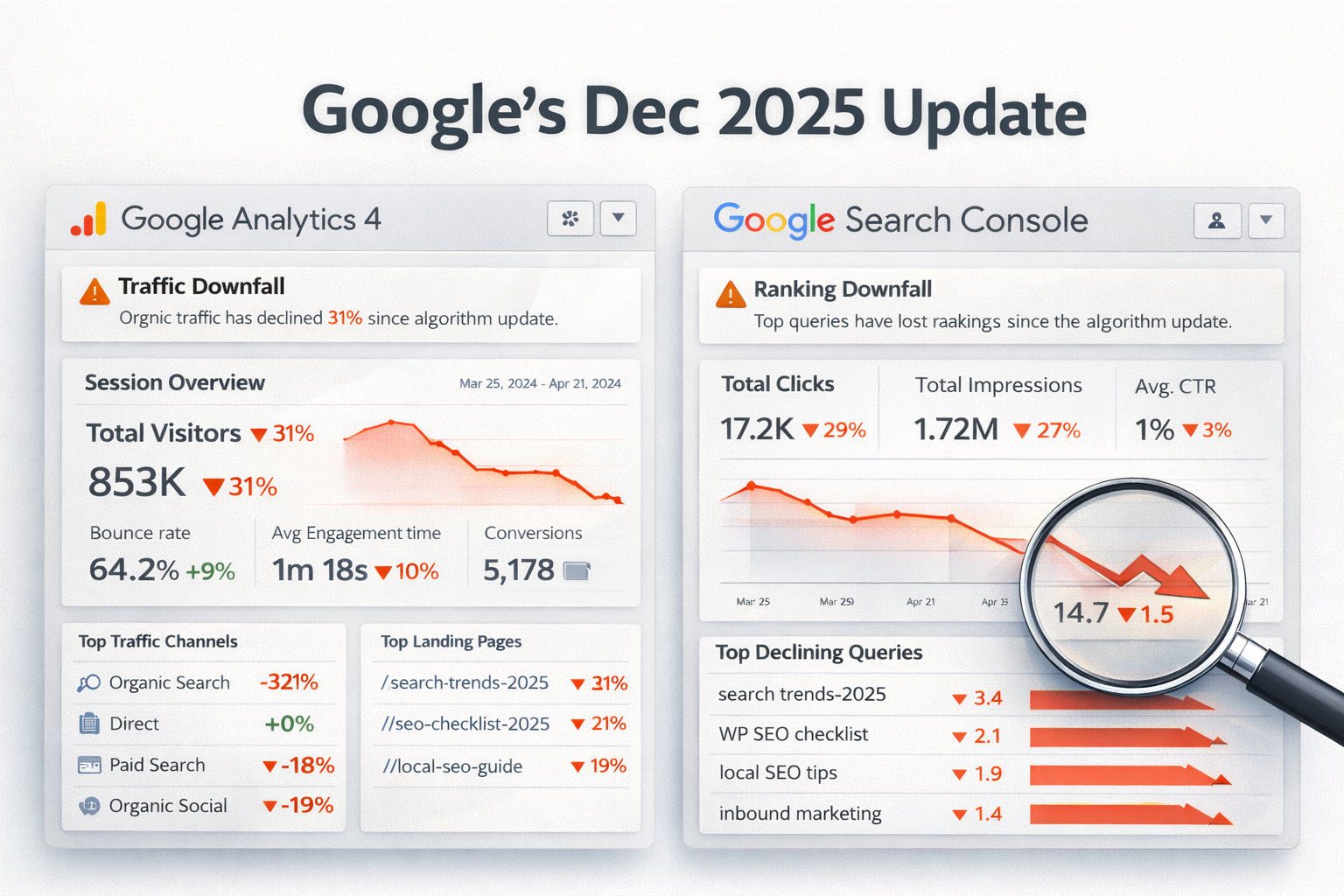
The December 2025 Google algorithm updates reinforced a fundamental shift that has been quietly reshaping search for several years: search visibility is no longer a function of content volume or CMS convenience, but of operational maturity.
For WordPress sites, this update functioned less as a disruption and more as an audit. Sites that had accumulated technical debt, content sprawl, and ungoverned growth experienced volatility. Those operating WordPress as a disciplined publishing system—clear ownership, strong performance controls, and editorial accountability—largely held ground or improved.
The practical takeaway is not that WordPress is “penalized,” but that it is now evaluated with fewer assumptions and more scrutiny. The platform’s flexibility is no longer a buffer against quality signals; it is a responsibility.
The update confirmed a broader reality: WordPress SEO is no longer about optimization tactics. It is about operating discipline.
Industry Context & Why This Matters Now
WordPress powers a substantial share of the public web, particularly in content-heavy sectors such as publishing, education, SaaS marketing, and small-to-mid enterprise commerce. That ubiquity has also made it one of the most heavily exploited CMS ecosystems—by low-quality publishers, scaled content operators, and short-term SEO plays.
Across mature WordPress installations, industry crawl studies consistently show that 30–60% of indexed URLs receive little to no organic traffic over 12 months.
The extensive presence of inactive URLs—frequently attributed to factors such as taxonomies, pagination, and outdated content—results in significant crawl inefficiencies and diminishes the overall quality signals of the website.
Over the past 24 months, Google has systematically closed the gap between how quality is described in its documentation and how it is enforced algorithmically. The December 2025 updates accelerated this shift by tightening evaluation around three areas that disproportionately affect WordPress sites:
- CMS-level footprint signals (templates, archives, duplication patterns)
- Real-user performance and interaction metrics
- Content accountability and provenance
The result is a growing separation between WordPress sites run as editorial products and those run as SEO factories.
The Post-Scale Reckoning
Between 2020 and 2024, three forces reshaped the web:
- Low-cost content production
- Widespread programmatic publishing
- CMS-driven expansion without proportional governance
WordPress absorbed much of this growth. The result was an index increasingly populated by pages that existed only because they could, not because they should.
The December 2025 updates represent a continuation of Google’s effort to reverse this imbalance—not by banning scale, but by pricing it correctly.
The End of CMS Neutrality
For much of the past decade, Google treated content management systems as largely interchangeable vessels. A URL was evaluated on its own merits, with limited contextual inference about the platform behind it.
That posture has changed.
As Google’s systems have matured, CMS-level patterns—template reuse, taxonomy behavior, internal linking logic, content lifecycle signals—have become increasingly legible. WordPress, due to its market share, offers Google an unusually large dataset of comparable implementations.
When enough low-quality patterns repeat at scale, they stop being edge cases and start informing baseline assumptions.
Market Pressure from Scaled Content
Between 2021 and 2024, the web experienced an unprecedented surge in low-cost content production. WordPress was the default infrastructure for much of this expansion.
By late 2025:
- Large portions of the index consisted of pages receiving no measurable user engagement
- Entire domains were ranking primarily due to internal linking and template authority rather than differentiated value
- Search results in many verticals showed declining diversity and originality
The December 2025 updates were part of a broader correction—less about punishment, more about recalibration.
Core Analysis: What Actually Changed for WordPress Sites
3.1 CMS Footprints Are No Longer Neutral
Historically, WordPress benefited from a degree of algorithmic leniency. Default taxonomies, paginated archives, tag pages, and author feeds were often crawled but not aggressively evaluated.
That tolerance has eroded.
WordPress creates content by default, not by intent.
Author archives, tag pages, paginated feeds, date-based URLs, and attachment pages—these are not inherently harmful. The issue arises when they are indexed without purpose.
Post-update observations show that Google increasingly distinguishes between:
- Intentional content structures (curated categories, editorial hubs)
- Incidental structures generated by CMS defaults
Sites that failed to draw this distinction saw crawl inefficiencies, diluted internal authority, and uneven ranking behavior across otherwise similar content.
This signals a shift toward structural intent recognition—Google inferring whether a site understands its own architecture.
Google’s crawl and ranking systems increasingly distinguish between intentional architecture and incidental CMS output.
WordPress sites that showcase well-organized category structures and strategically limit archive indexation experience a more dynamic and stable crawl allocation compared to those that depend on the default taxonomy behavior. Embrace the power of structured categories and watch your site’s performance soar!
In December 2025, WordPress-specific structural patterns began to behave less like neutral scaffolding and more like ranking liabilities when left unmanaged. Sites with uncontrolled index bloat, near-duplicate archive pages, and templated internal linking structures experienced measurable volatility—even when their primary content was sound.
This was not a penalty. It was prioritization.
Google increasingly treats large WordPress sites as systems rather than collections of URLs.
3.2 Performance Signals Shifted from Lab Metrics to Lived Experience
While Core Web Vitals have been part of ranking systems for years, the December 2025 changes further reduced the relevance of synthetic optimization.
WordPress sites that scored well in PageSpeed tools but exhibited poor real-user interaction—especially around input delay, script execution, and layout instability—lost ground. Page builders, ad stacks, analytics layers, and third-party embeds became compounding risks rather than isolated issues.
The message was unambiguous: optimization that exists only for testing tools no longer counts.
Enterprise monitoring across media and SaaS publishers showed that:
- Sites with strong lab scores but heavy client-side scripting underperformed expectations
- Interaction latency correlated more strongly with ranking stability than raw page load times
- Mobile experiences suffered disproportionately due to stacked plugins, ad tech, and analytics layers
For WordPress, this exposes a core tension: convenience-driven extensibility versus execution discipline.
3.3 Content Evaluation Moved Upstream
Google’s helpful content systems increasingly operate at the site and section level, rather than purely at the page level.
For WordPress publishers, this meant that legacy content, abandoned categories, and low-accountability posts written years ago began to influence the performance of newer, higher-quality work. Sites that continued to publish without pruning or editorial review found their marginal gains shrinking.
The update did not target AI content directly. It targeted unaccountable content—regardless of how it was produced.
Google’s systems increasingly evaluate:
- Content consistency across sections
- Editorial coherence over time
- The ratio of maintained to abandoned pages
WordPress sites with years of accumulated posts—many outdated, thin, or redundant—began to experience sitewide dampening, even when newer content met modern standards.
This suggests that historical neglect now carries a measurable cost.
3.4 Trust Is Being Inferred, Not Declared
WordPress plugins can generate schema, author boxes, and review markup in minutes. The December 2025 update made it clear that these signals are now interpreted contextually rather than accepted at face value.
Author schema, review markup, and expertise claims now function more like hypotheses than proofs. Google tests these signals against observable reality:
- Does the author appear consistently?
- Is expertise demonstrated across multiple works?
- Do external references align with internal claims?
WordPress sites relying on auto-generated credibility signals without editorial substance saw diminishing returns.
Sites that declared expertise without demonstrating it—through consistent authorship, visible editorial standards, or real-world validation—saw diminishing returns from structured data alone. Trust signals must now align with observable patterns across the site, not just metadata.
Data, Evidence & Real-World Signals
While Google does not release granular impact data, several consistent patterns emerged across enterprise SEO monitoring platforms and agency-led audits:
- Content-heavy WordPress sites with more than 40% of indexed URLs receiving no organic traffic were more volatile than leaner peers.
- Sites running multiple page builders or excessive third-party scripts showed disproportionate losses tied to interaction metrics.
- Recovery trajectories favored sites that removed content and simplified architecture rather than those that published more aggressively.
Industry commentary from large publishers and SEO platforms echoed the same conclusion: technical cleanliness and editorial restraint mattered more than expansion.
Vertical-Specific Impact & Examples
5.1 SaaS: Documentation, Content Marketing, and Trust Debt
SaaS companies often rely on WordPress for:
- Blogs and thought leadership
- Help centers and documentation
- Comparison and landing pages
Post-December 2025, several SaaS patterns emerged:
Common risks
- Overlapping blog and documentation content
- Comparison pages are generated primarily for SEO
- Blog velocity disconnected from product expertise
Observed outcomes
SaaS sites with clear separation between marketing content and product documentation performed better. Those that blurred the lines—republishing surface-level content across multiple formats—saw diminishing returns.
Companies that invested in:
- Named authors with real product ownership
- Regular content updates tied to product changes
- Learner taxonomy structures
demonstrated stronger ranking stability.
Strategic implication
For SaaS, WordPress SEO is now inseparable from product credibility. Content must reinforce actual product understanding, not abstract keyword opportunity.
5.2 Media & Publishing: Volume Without Governance No Longer Scales
Media organizations have long used WordPress as a high-velocity publishing engine. That model is under strain.
Key challenges
- Archive bloat across years of daily publishing
- Thin articles tied to short-lived trends
- Aggressive internal linking that flattens authority
Post-update pattern
Publishers that maintained clear editorial hierarchies—pillar topics, evergreen hubs, and update cycles—retained visibility. Those that prioritized output without lifecycle management saw volatility concentrated in long-tail traffic.
Several media organizations observed that reducing publication volume while increasing update frequency stabilized rankings more effectively than maintaining high daily output.
Strategic implication
For media, SEO advantage increasingly comes from curation, not coverage.
5.3 Education: Authority, Maintenance, and Structural Clarity
Educational institutions and platforms face unique pressures:
- Large content libraries
- Long content lifespans
- Diverse contributor bases
WordPress is often used to host:
- Course descriptions
- Learning resources
- Blog content for discovery
Observed risks
- Outdated content left indexed indefinitely
- Inconsistent authorship signals
- Fragmented topic coverage
Positive signals
Education sites that:
- Clearly dated and updated content
- Linked material to credentialed contributors
- Consolidated overlapping resources
performed better post-update.
Strategic implication
In education, freshness is less about novelty and more about stewardship. Google increasingly rewards evidence of ongoing care.
Strategic Implications for Businesses & Teams
6.1 WordPress Requires Governance, Not Just Optimization
SEO responsibility can no longer sit solely with marketing teams configuring plugins. Engineering, content leadership, and product stakeholders must share ownership of how WordPress is structured, maintained, and evolved.
SEO outcomes increasingly reflect how WordPress is governed:
- Who approves new content types?
- Who owns taxonomy decisions?
- Who is accountable for performance regressions?
Organizations treating SEO as a post-publish checklist are structurally disadvantaged.
6.2 Publishing Velocity Is a Risk Multiplier
High publishing velocity without proportional editorial oversight increases long-term risk. Every new post becomes part of a cumulative quality profile.
In several sectors, slower publishers with stronger editorial standards outperformed higher-output competitors post-update.
6.3 Legacy Content Is a Strategic Asset—or Liability
Content does not age gracefully by default. WordPress sites that institutionalized content audits—rather than one-off cleanup projects—showed greater long-term resilience.
Risks, Limitations & Trade-offs
WordPress remains flexible, but that flexibility creates exposure:
- Plugin ecosystems introduce performance and security risks that compound over time.
- Decentralized authorship models dilute accountability.
- Programmatic or templated growth strategies now carry higher downside than upside.
- Excessive consolidation can flatten nuance and intent
- Performance hardening may limit marketing agility
Conversely, over-pruning or excessive noindexing can harm discoverability if executed without strategic intent. The margin for error has narrowed, not widened.
Actionable Recommendations
- Audit the index, not just rankings
Evaluate what Google is choosing to crawl and retain, not only what ranks. - Treat performance as an engineering concern
Reduce reliance on front-end fixes and address systemic script and render-blocking issues. - Establish editorial ownership
Every content section should have a clear owner and review cadence. - Prune deliberately, not reactively
Remove or consolidate content that no longer serves a user or strategic purpose. - Align trust signals with reality
Author bios, schema, and claims should reflect verifiable expertise.
Forward-Looking Outlook (12–36 Months)
Looking ahead, Google’s direction suggests continued convergence between search quality systems and product-quality evaluation. WordPress sites that behave like mature digital products—measured, intentional, and well-maintained—will remain competitive.
Those that rely on automation, scale, or CMS defaults will face increasing friction.
Expect further tightening around:
- Interaction-based metrics
- Section-level quality scoring
- Cross-site reputation patterns
The era of “set-and-forget” WordPress SEO is effectively over.
Closing Perspective
The December 2025 Google algorithm updates did not signal the decline of WordPress. They signaled the end of casual WordPress SEO.
For organizations willing to treat WordPress as a serious publishing infrastructure—governed, audited, and aligned with real user value—the platform remains more than capable. For those seeking shortcuts, the cost of operating at scale has simply become too visible to ignore.
The gap between disciplined platforms and opportunistic ones is widening. Search is no longer forgiving—and WordPress sites are no exception.
Frequently Asked Questions
Is WordPress still a viable platform for SEO after the December 2025 updates?
Yes, but viability is now conditional. WordPress performs well when treated as a governed publishing platform with disciplined architecture, performance control, and editorial oversight. Sites relying on default configurations, excessive plugins, or scaled content tactics without quality control are increasingly disadvantaged.
Did the December 2025 update specifically target WordPress sites?
No explicit targeting occurred. However, WordPress sites are disproportionately affected because many share similar structural patterns—index bloat, templated archives, and plugin-driven duplication—that Google’s systems now evaluate more critically.
Are SEO plugins still useful, or have they lost relevance?
SEO plugins remain operational tools, not ranking solutions. They assist with hygiene and configuration but cannot compensate for weak content governance, poor performance, or low trust signals. Over-reliance on plugins without a platform-level strategy now presents more risk than reward.
How important is content pruning for WordPress SEO now?
Content pruning has shifted from optional to essential. Legacy pages, outdated posts, and low-performing archives actively influence site-level quality evaluation. Maintaining authority increasingly requires removal, consolidation, or restructuring—not continuous expansion.
Does AI-generated content cause ranking losses on WordPress?
AI usage itself is not the primary issue. Risk arises when content lacks accountability, originality, or real-world grounding. WordPress sites publishing high volumes of undifferentiated or unreviewed AI content tend to underperform following the December 2025 update.
Are Core Web Vitals still a ranking factor for WordPress sites?
Yes, but emphasis has shifted toward real-user interaction signals rather than lab scores. Sites optimized for testing tools but delivering poor lived experiences—particularly around interaction latency—are unlikely to benefit.
What role does site architecture play in post-2025 WordPress SEO?
Architecture is now a first-order concern. Crawl efficiency, internal linking logic, archive control, and URL prioritization directly influence how Google allocates attention and trust across WordPress sites.
Can small WordPress sites compete with enterprise publishers after these updates?
Yes. Smaller sites often benefit from clearer topical focus, lower index bloat, and stronger authorship signals. In many cases, simplicity and restraint outperform scale.
What is the biggest strategic mistake WordPress site owners are making now?
Continuing to publish without revisiting existing content and structure. Growth without governance amplifies risk and weakens overall site signals.
How often should WordPress sites reassess their SEO strategy going forward?
At a minimum, quarterly reviews are advisable for content-heavy sites. Structural audits and performance reviews should be ongoing, not reactive to ranking losses.


