







But the system has evolved. Today, broad targeting is not laziness. In many cases, it is aligned with how Meta’s algorithm actually learns.
The real question is no longer whether broad targeting works. It’s when it works, and why it sometimes fails.
Why Broad Targeting Often Performs Better Today
Meta’s algorithm is designed to optimize delivery based on user behavior. When you give it space, it can observe engagement patterns, analyze post-click behavior, and refine delivery toward users who respond positively. Broad targeting gives the system more data, more variation, and more opportunities to learn.
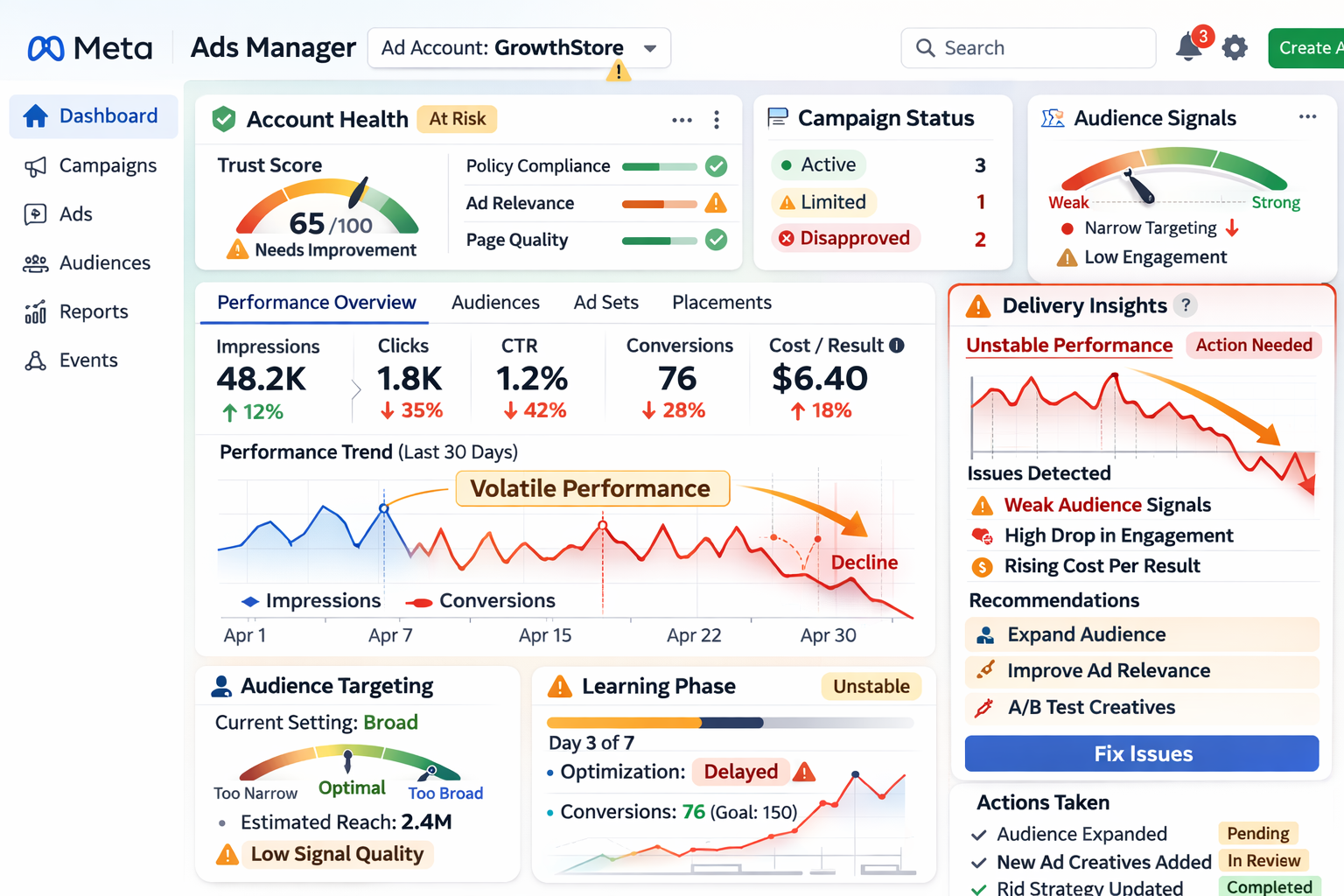
When advertisers restrict audiences too tightly, they often reduce signal volume. With fewer impressions and fewer behavioral inputs, the algorithm struggles to identify meaningful patterns. Broad targeting increases signal flow, and signal flow fuels optimization.
This reflects the larger shift in the platform, where Meta Ads now prioritizes signals over targeting, allowing machine learning to identify resonance more effectively than manual segmentation.
What Makes Broad Targeting Work
Broad targeting is not magic. It works best when supported by strong creative and clear positioning. If your message is vague, generic, or confusing, broad targeting will amplify that weakness rather than solve it.
Clear creatives act as natural filters. They attract the right attention and repel the wrong kind. When paired with broad targeting, this self-selection process gives the algorithm strong, clean engagement signals.
Strong landing page alignment also matters. If users click and immediately leave, the algorithm receives mixed signals. If they stay, scroll, and convert, delivery improves quickly. Broad targeting only works when the rest of the system is healthy.
When Broad Targeting Fails
Broad targeting tends to fail when advertisers expect it to compensate for unclear messaging. If your offer lacks specificity, if your creative does not clearly signal who it is for, or if your landing experience creates friction, the algorithm cannot learn effectively.
It can also struggle in highly niche markets witha very limited audience size. In those cases, some guardrails may still help guide delivery. The key is not to over-constrain, but to provide just enough structure to maintain relevance.
Another common failure point is impatience. Broad targeting requires learning time. Frequent campaign resets, constant creative overhauls, and rapid budget swings interrupt optimization before it stabilizes.
Broad Does Not Mean Blind
One misconception is that broad targeting means removing all structure. In reality, it means shifting the structure from audience definitions to creative clarity and conversion optimization.
You still define geography, age ranges, and basic guardrails. What you avoid is over-layering interests and micro-segments that restrict signal discovery.
Broad targeting works when you trust the algorithm to find patterns in behavior rather than trying to predefine those patterns yourself.
How to Test Broad Targeting Safely
If you are hesitant to go fully broad, testing is the most reasonable approach. Run a broad campaign alongside a narrower control campaign and compare cost per result, learning stability, and signal consistency.
Focus on downstream metrics such as time on page, conversion rate, and engagement depth rather than surface-level clicks. Those metrics better reflect how the algorithm is learning.
In many cases, advertisers discover that broad targeting does not increase wasted spend; it increases learning speed.
The Real Strategic Shift
The debate around broad targeting is really a debate about control. Older advertising models rewarded manual precision. Modern Meta Ads reward signal clarity and system cooperation.
Broad targeting represents a willingness to let the machine observe, adapt, and refine. It shifts the advertiser’s role from audience selector to signal architect.
In the current environment, success comes not from narrowing the funnel, but from strengthening what flows through it.
The Takeaway
Broad targeting works when the creative is clear, signals are strong, and trust is built over time. It fails when messaging is vague, signals are weak, or campaigns are reset too quickly.
The goal is not to abandon structure, but to place structure where it matters most: in creative strategy, user experience, and consistent optimization.
When those elements align, broad targeting stops feeling risky and starts feeling efficient.


