










That balance has quietly flipped. Today, your creative is doing far more of the targeting work than your audience settings ever could.
This shift can feel unsettling, especially for advertisers trained to believe that targeting is strategy and creative is execution. But in the current Meta Ads ecosystem, creatives are no longer just messages for people; they are instructions for the algorithm.
How Creatives Function as Filters
Every creative you run sends a signal before a user ever clicks. The tone, pacing, visuals, and framing immediately attract some people and repel others, and those reactions shape who the ad is shown to next.

A slow, explanatory video naturally filters for users willing to spend time watching. A fast, high-energy reel attracts a very different type of attention. Without changing a single targeting setting, the creative itself determines who engages.
This is why two ads with identical audiences can perform completely differently. The algorithm is responding to behavior, not intent, and behavior is driven by how the creative feels to the viewer.
Why Narrow Targeting Can Actually Hurt Performance
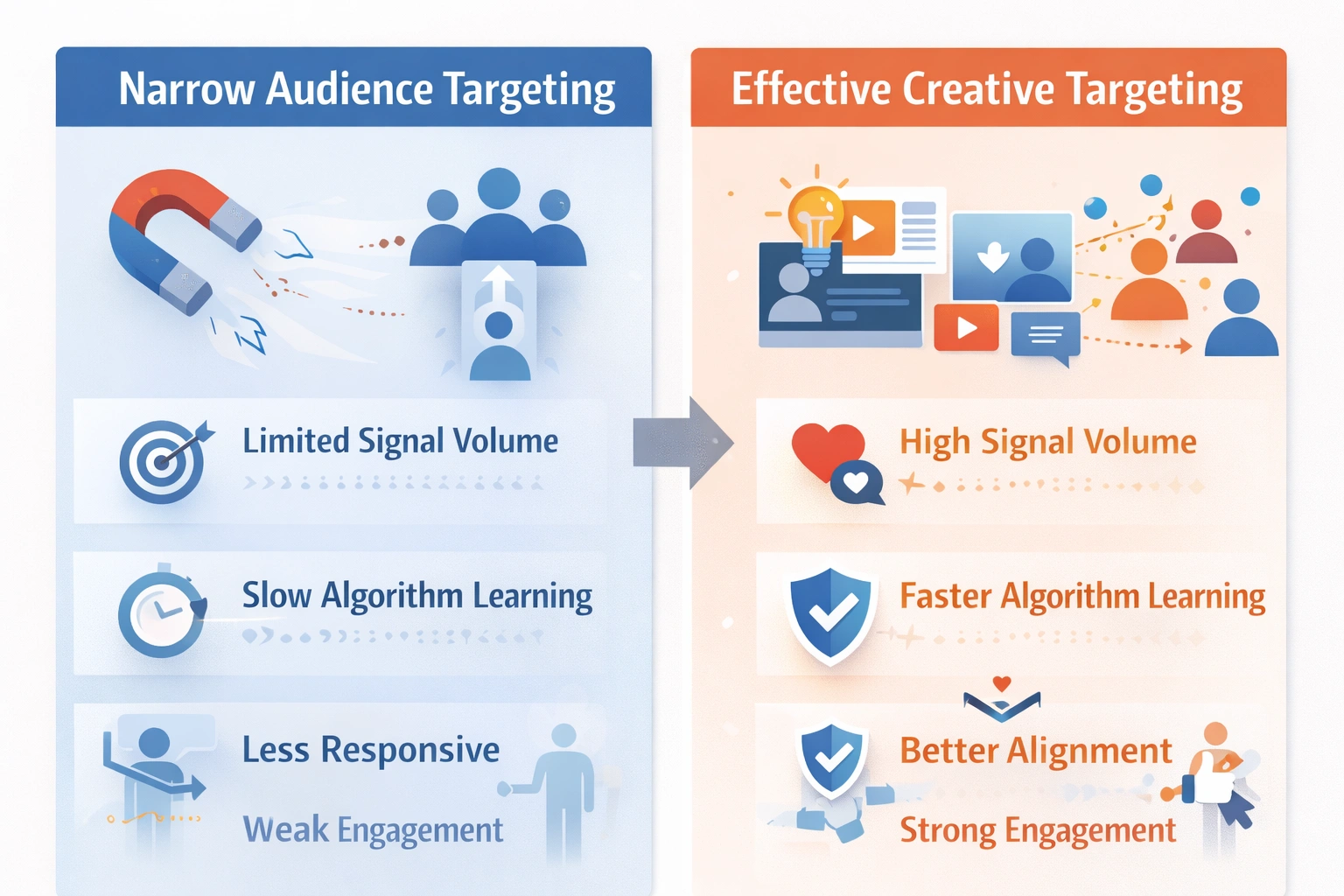
When advertisers combine narrow targeting with highly specific creatives, they often reduce the system’s ability to learn. The audience becomes too small, the signal volume too low, and the algorithm struggles to identify meaningful patterns.
Broad targeting paired with clear creatives gives Meta room to explore. It allows the system to test different segments, observe engagement, and refine delivery based on real responses rather than assumptions.
This is one of the reasons modern best practices increasingly recommend starting broad and letting the creative do the filtering. It aligns with the reality that Meta Ads now prioritize signals over targeting, not the other way around.
Creative Clarity Beats Cleverness
Another misconception is that better creative means more clever creative. In practice, clarity tends to outperform novelty. Ads that clearly state who they are for and what they offer generate cleaner signals than ads that try to be everything to everyone.
When users immediately recognize themselves in a message, they engage more intentionally. That engagement teaches the algorithm faster and with greater confidence.
This is why educational, explanatory, and problem-aware creatives often perform well. They may not look flashy, but they create alignment between message and audience behavior.
The Algorithm Is Watching Patterns, Not Individual Ads
Meta’s system does not evaluate creatives in isolation. It looks for patterns across ads, campaigns, and time. When you repeat a message with small variations, the algorithm can connect engagement signals and learn more efficiently.
Constantly reinventing your creative approach can reset that learning. While experimentation is necessary, it works best when done within a consistent framework rather than through constant reinvention.
Many high-performing advertisers reuse the same core creative structure for months, refining details rather than starting over. What looks repetitive to humans often looks reliable to machines.
What This Means for Creators and Small Teams
For creators, educators, and small teams, this shift levels the playing field. You no longer need sophisticated audience research tools to compete. You need strong ideas expressed clearly.
If your creative communicates value honestly and your landing experience matches that promise, the system can do much of the distribution work for you. The algorithm is not searching for perfect targeting; it is searching for resonance.
This makes creative strategy less about persuasion and more about alignment. The goal is not to convince everyone, but to clearly signal who the message is meant for.
The Takeaway
If your Meta Ads are underperforming, the problem is rarely that the audience is wrong. More often, the creative is sending mixed or weak signals.
Instead of asking who you should target, start asking who your creative is speaking to and what behavior it encourages. When those answers are clear, the algorithm follows.
In today’s Meta Ads environment, creative is not decoration. It is the targeting.


