









That era is over.
Today, Meta Ads are less about who you target and far more about what signals you send, how your creative communicates, and whether the platform trusts your account. The change has been gradual, but unmistakable—and for many advertisers and creators, deeply confusing.
Campaigns that once worked flawlessly now struggle. Carefully built audiences underperform. Meanwhile, broad targeting with strong creatives quietly wins.
This is not a bug in the system. It is the system.
The Quiet Death of Precision Targeting
Apple’s App Tracking Transparency update is often cited as the turning point, but the real shift runs deeper. Meta has been moving away from advertiser-controlled targeting for years, steadily centralizing decision-making inside its own machine learning systems.
Interest targeting still exists, but its influence has weakened. Behavioral signals are noisier. Lookalike audiences are less predictable. Even retargeting—once the most reliable tool in the box—no longer guarantees results.
What replaced them is something less visible and harder to manipulate: signal quality.
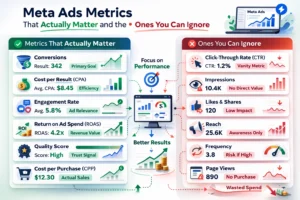
Instead of asking who did you target, Meta’s systems now ask how users behave after seeing your ad, whether they stop scrolling, whether they watch, click, save, comment, or convert, whether they bounce quickly or engage meaningfully, and whether these behaviors repeat consistently across impressions.
In other words, Meta is no longer optimizing for audience definitions. It is optimizing for patterns of response.
Signals: The New Currency of Meta Ads
A signal is any action—or inaction—that helps Meta understand how people experience your ad.
Clicks matter less than what happens after the click. Impressions matter less than what people do with them.
Strong signals include watching a video past the first few seconds, expanding captions or saving posts, completing landing page actions without hesitation, and consistent conversion behavior over time.
Weak signals include accidental clicks with quick exits, high bounce rates, mismatched messaging between ad and landing page, and sudden spikes followed by drop-offs.
Meta’s AI uses these signals to decide who should see your ad next—not because you told it who to target, but because user behavior revealed who responds.
Creatives Are Now the Targeting
If targeting no longer does the heavy lifting, creatives do.
Your ad creative—visuals, copy, format, and pacing—is now the primary input into Meta’s delivery engine. It tells the algorithm who the ad is for, even when you don’t explicitly define that audience.
In effect, creatives have become self-selecting audiences.
This is why small creative changes can outperform major targeting adjustments. The system reads creative signals faster and more accurately than manual audience logic.
Trust: The Invisible Layer Most People Ignore
Beyond signals and creatives lies a quieter, more consequential factor: account trust.
Meta builds a reputation profile for each ad account, page, and domain over time based on policy compliance, predictable spend patterns, stable performance history, honest messaging aligned with landing pages, and user feedback such as ad dismissals.
Trust is not built in a campaign. It is built over time.
Why “Winning” Campaigns Look Boring Now
High-performing Meta ads often look unremarkable. They repeat messages with small variations instead of constant reinvention because the system rewards consistency it can learn from rather than novelty for its own sake.
The New Mental Model
Send clear signals. Earn trust. Let the system find resonance.
Meta Ads are no longer about control. They are about cooperation.
Strong signals, thoughtful creatives, and earned trust are the levers that matter now.
Related Meta Ads Guides
- How Meta’s Algorithm Learns From Signals
- Why Creatives Matter More Than Targeting
- How Meta Ad Account Trust Works
- Broad Targeting on Meta Ads Explained


