








What Meta Actually “Sees” When Your Ad Runs
When your ad enters the auction, Meta does not simply check whether it matches an interest or demographic. Instead, it observes how real people respond in real time. Does someone pause their scroll? Do they watch the video for more than a moment? Do they tap, save, comment, or move on without a second thought?
These reactions are signals, and signals are the raw material Meta’s algorithm uses to learn. Some signals are obvious, like clicks or purchases, but many are subtle and invisible to advertisers. Scroll speed, hesitation, engagement depth, and post-click behavior all contribute to how the system interprets your ad’s relevance.
Over time, Meta builds a pattern. It begins to recognize what kind of user responds positively to your creative, even if you never explicitly told it who that user is. This is why the platform can often outperform manual targeting, especially when given enough data to learn.
Why Clicks Matter Less Than You Think
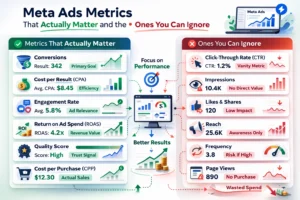
One of the most common misunderstandings about Meta Ads is the role of clicks. For years, clicks were treated as the primary success metric, but today they are often misleading. A click that leads to a quick bounce teaches the algorithm very little, and sometimes teaches it the wrong lesson.
What matters more is what happens after the click. Does the landing page load quickly? Does the content match the promise of the ad? Does the visitor stay, scroll, read, or complete an action without friction? These post-click behaviors send much stronger signals than the click itself.
In practical terms, this means you can have a campaign with fewer clicks but better performance if those clicks are meaningful. Meta’s system is increasingly optimized to detect quality over quantity, even when advertisers are still focused on surface-level metrics.

How Creatives Teach the Algorithm Who Your Ad Is For
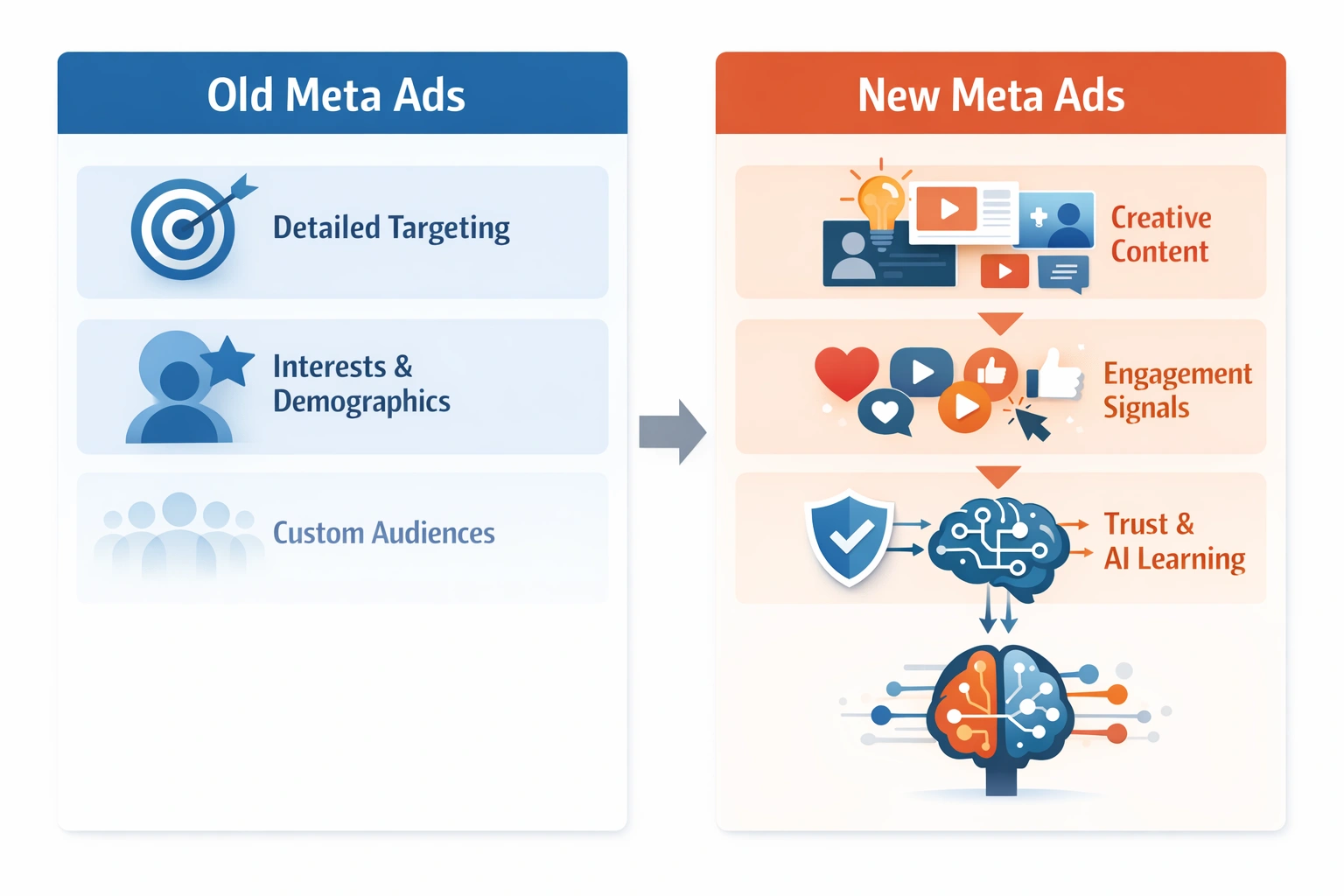
Your creative is not just a message for users; it is also a message for the algorithm. The tone, pacing, visuals, and structure of an ad all influence who engages with it, and those engagements shape future delivery.
A calm, educational video will attract a different audience than a high-energy promotional clip. A thoughtful headline filters differently than a bold sales claim. Without any manual targeting changes, your creative choices effectively define your audience through behavior.
This shift is part of a broader reality that Meta Ads now prioritize signals over targeting, rewarding clarity and engagement instead of narrow audience definitions.
The Role of Consistency in Learning
Meta’s algorithm learns best when it has stable patterns to analyze. Frequent, dramatic changes in messaging, structure, or landing pages can interrupt that learning process, forcing the system to start over repeatedly.
This does not mean creativity should be stagnant, but it does mean consistency matters. Repeating proven creative frameworks with small variations helps the algorithm connect user behavior across ads and build confidence in delivery.
Many high-performing campaigns look boring from the outside because they are designed to be legible to a machine as well as engaging to a human. Predictability, in this context, is not a weakness; it is a signal.
Why Broad Targeting Often Works Better Now
As Meta’s ability to learn from signals has improved, the need for narrow targeting has diminished. Broad targeting gives the system room to explore, test, and refine delivery based on real responses rather than assumptions.
When advertisers over-constrain audiences, they limit the algorithm’s ability to find patterns. Broad targeting, paired with clear creatives and strong post-click experiences, allows Meta to discover receptive users faster and more efficiently.
Thinking About Meta Ads as a Feedback Loop
The most effective way to understand Meta Ads today is to view them as a feedback loop. You send a message into the system through your creative and landing page. Users respond through their behavior. The algorithm learns from those responses and adjusts delivery accordingly.
When performance drops, the cause is often not the audience, but unclear signals. When performance improves, it is usually because the system has learned who resonates with your message.
The Takeaway for Beginners
If you are new to Meta Ads, the most important thing to understand is that the algorithm is not working against you. It is responding to the information you provide, whether intentionally or not.
Focus on creating ads that people genuinely want to engage with. Make sure your landing pages deliver on the promise of your creative. Give campaigns enough time and consistency to learn.
When you do that, targeting becomes less of a lever and more of a guardrail, and Meta’s system can do what it was designed to do: match messages with the people most likely to care.


