






Introduction — The state of UX/UI in 2026
In 2026, UX/UI design is less about static screens and more about adaptive, AI-assisted workflows that scale across devices—web, mobile, wearables, in-car interfaces, and mixed reality. Modern product teams need tools that accelerate creation, validate decisions with real users faster, and connect design to production more tightly than ever. Below are five tools that stand out not just for popularity, but for how they change what teams can build and test.
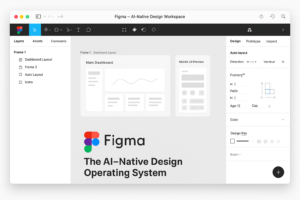
Figma 2026: The AI-Native Design Operating System
Figma remains the gold standard of collaborative design, but in 2026, it behaves more like a smart design engine than a static canvas. Built-in copilots and automation layers let designers generate, refactor, and assemble UI components using natural language.

Why it dominates in 2026
- AI component automation: Generate interfaces via prompts—”Create a settings modal with three tabs and smart animations”—and Figma executes, saving hours of repetitive work.
- Smart prototyping & real data mode: Prototypes can simulate live app data and conditional logic, making in-tool testing much closer to production behavior.
- Dev Mode 2.0: Converts designs into clean React or SwiftUI snippets, and keeps design tokens in sync with engineering.
Figma is now an ideation, production, and validation hub—ideal for designers building AI-driven flows and teams wanting tight designer-engineer collaboration.
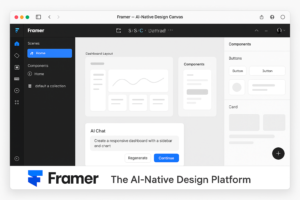
Framer AI: The Fastest Way to Build & Ship Websites in 2026
Framer excels at turning design intent into production-ready sites. With generative models inside the editor, teams can go from prompt to polished, responsive pages faster than with traditional design-to-code pipelines.

Why Framer is a must-have
- Prompt → production: Generate site structures, hero sections, and responsive variants in seconds.
- Zero-code interactions: Build states, logic, and animations without writing code.
- One-click hosting: Launch A/B-ready landing pages immediately, shortening validation cycles.
Great for startups, growth teams, and designers who want full control over motion and responsiveness while shipping production assets fast.
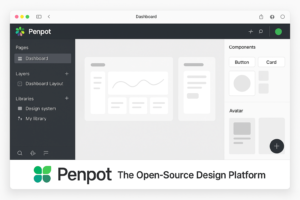
Penpot 2.5: The Open-Source Design Powerhouse for 2026
Open-source adoption has grown in design tooling—Penpot stands out for enterprises that want ownership, security, and CSS-native workflows.

Why Penpot is trending
- Open-source reliability: Customizable, auditable, and cost-effective for large orgs.
- Flex layout & component logic: Designers can work in a system that mirrors CSS behavior, reducing handoff friction.
- Design system governance: Multi-brand library sharing and roles & permissions for enterprise use.
Penpot is especially useful for dev-heavy teams and organizations, reducing dependency on SaaS pricing increases.
Maze AI Insights: Research Automation for 2026 UX Teams
Rapid UX research is now a competitive advantage. Maze automates the research pipeline: recruit participants, run tasks, and get AI-summarized insights quickly.


Why it matters
- Automated usability testing: From prototype upload to summarized findings in hours instead of weeks.
- Behavioral pattern detection: AI surfaces fail points, hesitations, and drop-off hotspots automatically.
- Continuous research streams: Always-on studies that continuously feed your product roadmap with signals.
Perfect for researchers on tight timelines, product managers validating features, and agile teams running rapid iterations.
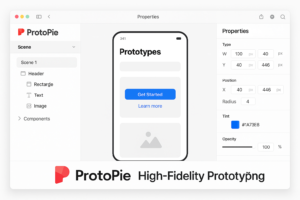
ProtoPie 2026: High-Fidelity Interaction Design Without Code
As interfaces expand to voice, spatial, and sensor-driven interactions, ProtoPie enables complex prototypes that behave like real products—without writing code.

Core strengths
- Real-device testing: Connect to wearables, car screens, and IoT devices for realistic testing.
- Multi-input interactions: Supports voice, gestures, pressure, and sensor-based triggers.
- Production-level microinteractions: Build state machines and complex logic visually.
Ideal for automotive, XR, voice-first, and advanced mobile interactions—ProtoPie turns futuristic concepts into testable prototypes.
Bonus — Tools rapidly rising in 2026
- Galileo AI — Text-to-UI generator that creates screens and variations from prompts.
- Relume — Component and site-builder for Webflow teams with AI-assisted architecture.
- Axure RP Next — Enterprise UX modeling with AI documentation and logic simulation.
- Zeplin Harmony — Dev-design workflow improvements with versioning and governance.
What this means for designers in 2026
Three core shifts define the era:
- AI as a collaborator: Designers work with copilots that can generate UIs, predict behavior, and automate documentation.
- Tools as full stacks: Figma, Framer, and others are evolving into platforms that cover ideation, production, and validation.
- Speed is strategic: Teams that prototype quickly and validate continuously will outpace competitors and cut development costs.
Final thoughts
2026 marks the full arrival of the AI-native design era. Designers who learn Figma, Framer, Penpot, Maze, and ProtoPie—while keeping an eye on rising tools—will be best placed to build the next generation of adaptive, intelligent interfaces.
If you want this exported as a ready-to-upload WordPress HTML file (or want a featured 1920×1080 PNG), I can prepare that next.


