






The Complete Software Developer Roadmap for 2026
Why You Need a Software Developer Roadmap
A roadmap gives structure to your learning. Without it, developers often fall into the “tutorial loop”—watching videos, copying code, but never becoming job-ready. A clear roadmap helps you learn the right skills in the right order, avoid overwhelm, build projects that demonstrate real work, and progress from junior-level to senior and leadership roles.
Fast fact: According to labor and industry analyses, demand for software developers continues to outpace supply worldwide. Having a structured roadmap increases your chances of landing meaningful jobs and internships.

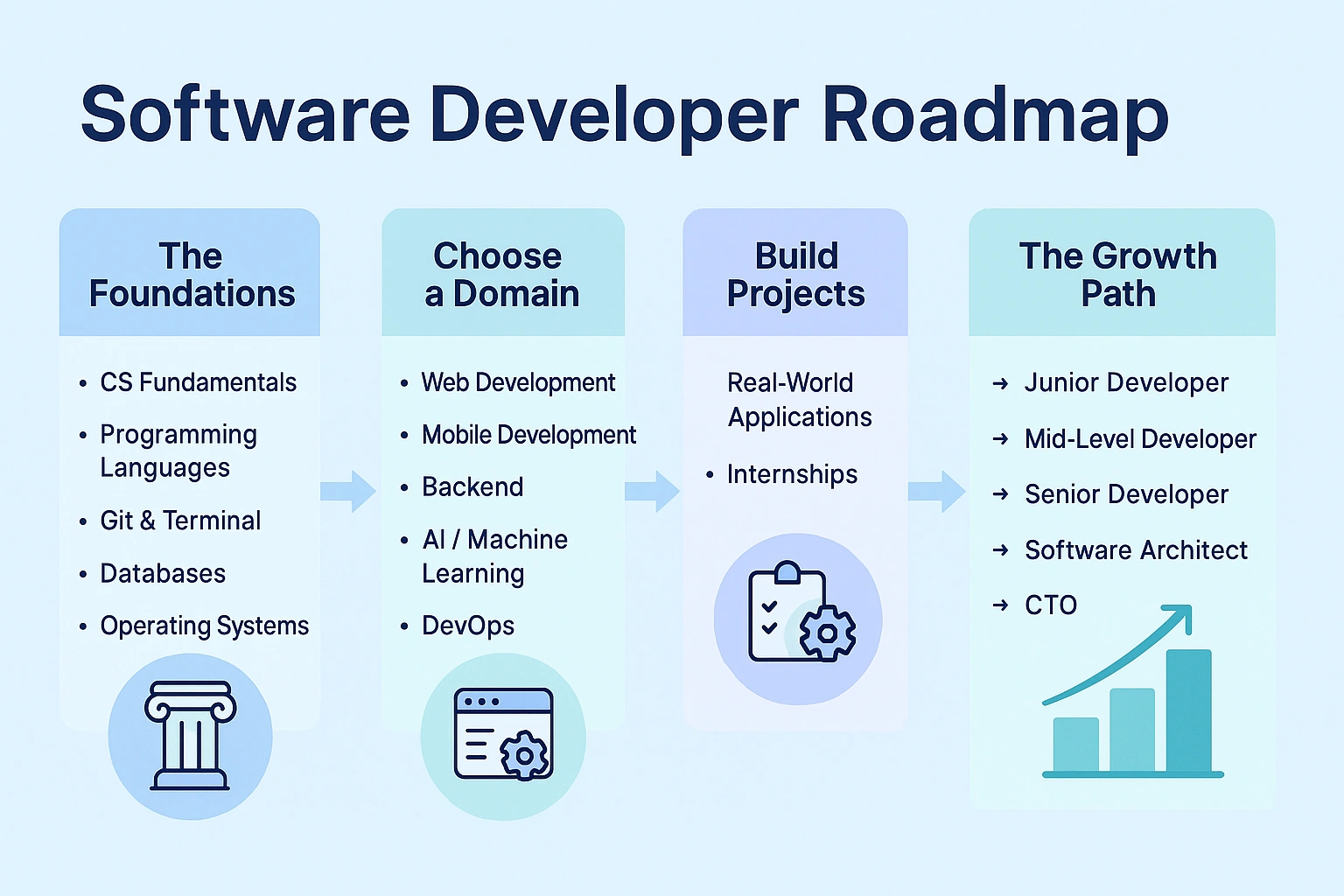
Phase 1: The Foundations — What Every Software Developer Must Learn
No matter which domain you choose, these core building blocks are non-negotiable. Think of them as the “grammar” of software—without them you can’t speak the language fluently.
2.1 Computer Science Fundamentals (CS Basics)
Even without a CS degree, understanding fundamentals separates average developers from exceptional ones. Study:
- How the internet works (DNS, HTTP/HTTPS, servers, latency)
- Client vs server architecture
- APIs and microservices basics
- Binary, compilers, interpreters
- Cloud basics
When debugging production issues, knowledge of fundamentals helps you determine whether slowness is caused by the API, the database, the network, or the cloud provider.
2.2 Learn Programming Fundamentals
Start with one beginner-friendly language. Recommended options:
- Python — great for beginners, scripting, AI, and backend
- JavaScript — mandatory for web development
- Java — enterprise and Android
- C# — .NET ecosystem
- Go — modern backend and cloud-native work
Master the basics: variables, conditionals, loops, functions, OOP, error handling, file & API handling, and basic algorithms.
Example exercises: build a CLI calculator, parse CSV files, or create a simple URL shortener.
2.3 Master Git & Version Control
Every developer must know Git:
- git init, status, add, commit
- branching and merging
- resolving merge conflicts
- pull requests and code reviews
- GitHub / GitLab workflows
Teams rely on Git-based workflows—so proficiency is essential to be employable in modern engineering teams.
2.4 Operating Systems Basics
Know enough OS to function: file systems, permissions, processes & threads, shell commands, environment variables, and package managers. These basics speed up troubleshooting dramatically.
2.5 Data Structures & Algorithms (DSA)
Core topics: arrays, linked lists, stacks, queues, trees, graphs, hash maps, sorting & searching, and complexity analysis. Strong problem-solving skills make you far more effective in complex engineering contexts.
Choosing Your Domain: Where Do You Want to Specialize?
After mastering fundamentals, specialize in one primary domain and optionally a secondary supporting skill. Below are five high-growth domains with key skills and project ideas.
3.1 Web Development (Frontend + Backend + Full Stack)
Web development offers the lowest entry barrier and the highest job demand.
- Frontend: HTML5, CSS3, JavaScript, responsive design, frameworks (React, Vue, Angular), UI libraries (Tailwind, Bootstrap).
- Backend: Node.js, Python (Django/Flask/FastAPI), Java Spring Boot; databases like PostgreSQL and MongoDB; REST & GraphQL.
Project ideas: e-commerce app, SaaS dashboard, full-stack blog, portfolio builder.
3.2 Mobile App Development
Mobile remains critical for companies shifting to app-first strategies.
- Native Android: Kotlin
- Native iOS: Swift
- Cross-platform: Flutter or React Native
Project ideas: fitness tracker, chat app, social feed app.
3.3 Backend Engineering
For those who love systems, APIs, scalability, and performance.
- Languages: Node.js, Go, Java, Python
- Databases (SQL + NoSQL), message queues (Kafka), caching (Redis)
- Microservices design, API security, cloud services
3.4 Artificial Intelligence & Machine Learning
AI/ML roles are expanding fast. Learn Python, data libraries (NumPy, Pandas), ML basics, deep learning (PyTorch, TensorFlow), LLMs & model deployment.
3.5 DevOps & Cloud Engineering
Learn Linux, Docker, Kubernetes, CI/CD, Terraform, and a major cloud (AWS/Azure/GCP). DevOps practices accelerate delivery and reliability.
Industry stat: Organizations practicing modern DevOps deploy far more frequently and recover faster from incidents (DORA reports).
Building Projects, Internships & Your Developer Portfolio
After choosing a domain, build meaningful projects and experiences that hiring managers care about.
4.1 Build Real-World Projects (Not Tutorials)
Tutorials teach syntax. Projects teach engineering. Recruiters look for code quality, commit history, authentication, database use, and deployment.
Good projects include authentication systems, a weather dashboard, a full-stack blog, an AI chatbot, an expense tracker with charts, or a realtime chat app with WebSockets.
4.2 Internships & Industry Experience
Internships accelerate hiring: you’ll learn teamwork, production debugging, and gain mentorship. Search on LinkedIn, AngelList, local job boards, and contribute to open-source for exposure.
4.3 Building a Portfolio That Gets You Hired
Your portfolio must show an About page, skills, projects with live links, case studies, GitHub and LinkedIn links. Bonus: blog posts, open-source contributions, and project walkthrough videos.
Tip: Projects with a deployed demo raise interview callbacks significantly compared to code-only examples.
The Growth Path: Junior → Mid-Level → Senior → Architect → CTO
Your career path is built on increasing technical depth, ownership, architecture understanding, and business impact.
5.1 Junior Developer (0–2 years)
Focus on reliable deliveries, following established patterns, and learning from reviews. Your goal: become dependable and independent.
5.2 Mid-Level Developer (2–5 years)
Own features, write production-ready code, mentor juniors, and learn system design basics. Your goal: own feature delivery end-to-end.
5.3 Senior Developer (5–10 years)
Seniors lead major features, design systems, debug production, improve performance, and mentor teams. Expect to be asked to design systems supporting high scale—e.g., an e-commerce backend for hundreds of thousands of monthly users.
5.4 Software Architect (8+ years)
Architects choose technologies, align engineering with business goals, set standards for maintainability, reliability, and cost-efficiency.
5.5 Engineering Manager → CTO (10–15+ years)
Transition to leadership involves people management, strategy, product alignment, and representing the technical vision to stakeholders and investors.
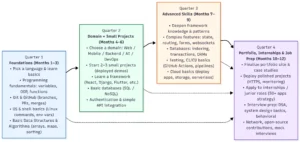
Suggested 12-Month Roadmap for Beginners
Here’s a practical timeline to go from zero to job-ready in one year if you commit consistently.
Months 1–3: Foundations
- Pick a language & learn programming basics
- Learn Git & GitHub
- Basic data structures & algorithms
Months 4–6: Choose a Domain & Start Projects
- Pick Web / Mobile / Backend / AI / DevOps
- Build 2–3 medium-sized projects and deploy them
Months 7–9: Advanced Skills
- Master a framework (React, Django, Spring, Flutter)
- Work on databases and APIs
- Learn deployment and basic cloud
Months 10–12: Portfolio, Internships & Interviews
- Finalize portfolio website with case studies
- Apply to internships & junior roles (aim for 50+ applications)
- Practice interviews & system design basics
Outcome: With persistent effort and real projects, you should be competitive for junior roles after 10–12 months.
Final Advice for Becoming a World-Class Developer
- Consistency beats intensity—code daily or several times a week.
- Build more projects than you consume tutorials.
- Ask for feedback and iterate quickly.
- Learn systems, not only syntax.
- Write clean, maintainable code and communicate clearly with teammates.
- Contribute to open-source and network in the community.
Software development is a marathon. With a clear roadmap, you’ll accelerate your learning and stand out in hiring processes.


