







1. Why Learn Machine Learning Now?
Machine learning powers recommendation engines, fraud detection, medical diagnostics, and autonomous systems—making it central to modern product and business strategy. Organizations across industries generate huge volumes of data and depend on ML to turn that data into product features and cost-saving automations. For learners this means an expanding job market and diverse industry applications.
Practical demand and salary levels remain high: companies value engineers who can not only build models but also ship them into production. For many learners, a portfolio of projects and demonstrable experience now outweigh formal degrees. The path to ML work is therefore accessible to anyone who commits to structured, project‑focused learning.
2. Skills You Need Before Starting ML
Start with basic programming literacy—variables, loops, functions, and data structures—preferably in Python. You’ll also benefit from familiarity with spreadsheets, CSV files, and a willingness to read documentation and experiment. These practical skills make advanced topics easier to pick up.
Analytical thinking is more important than advanced math at the outset. Machine learning follows repeatable steps: explore the dataset, prepare data, choose a model, train, evaluate, and iterate. If you enjoy problem decomposition and iteration, you’ll find ML approachable and rewarding.
3. The Zero‑to‑Hire 12‑Month Roadmap
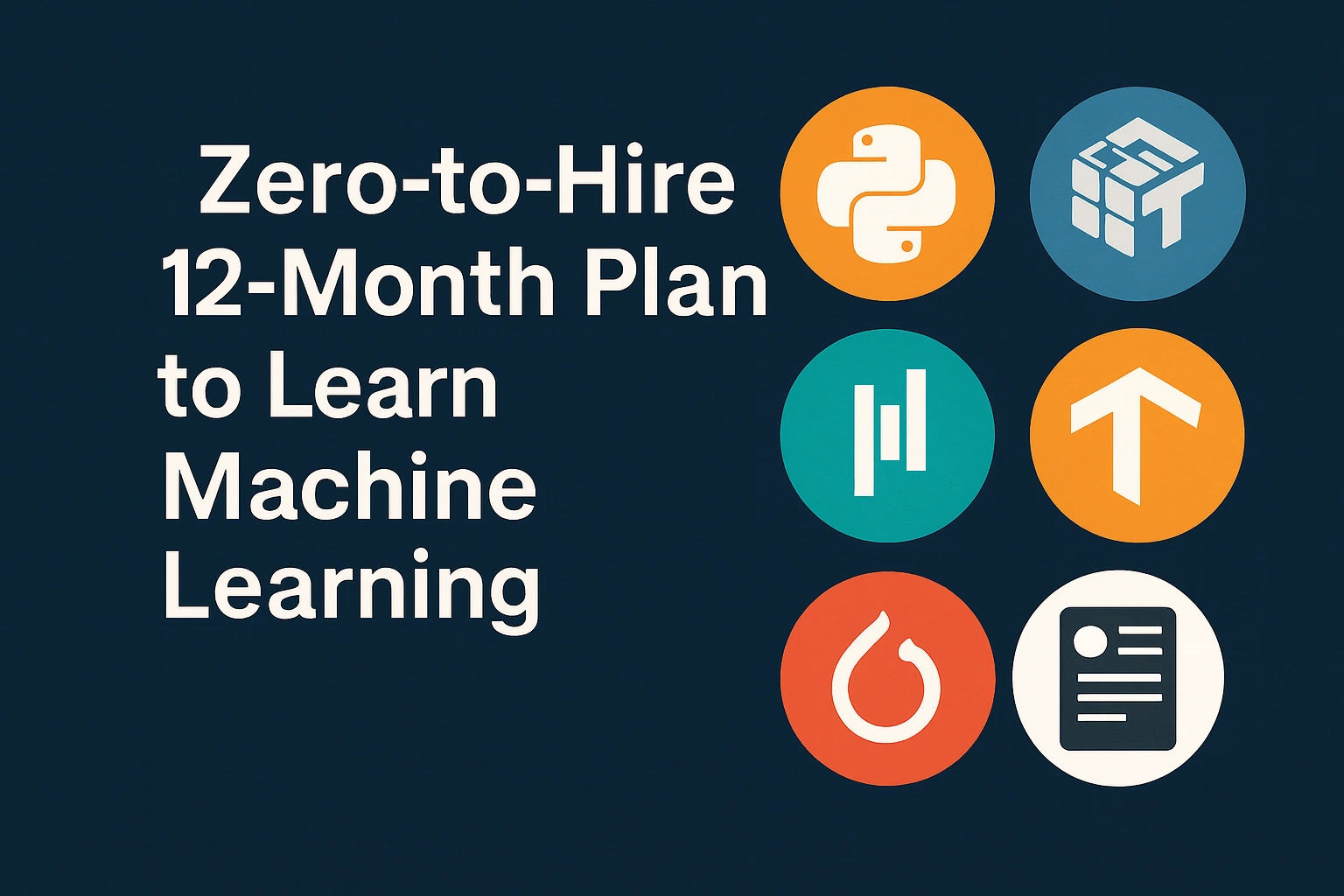
This month-by-month plan balances fundamentals, applied skills, and portfolio building so you can go from absolute beginner to hire-ready in a year. Aim for focused, consistent study (10–15 hours/week if possible) and prioritize projects that you can showcase on GitHub and in interviews.
Months 1–2: Python Foundations
Python is the primary language used across ML teams due to its readability and library ecosystem. Prioritize core syntax, data structures (lists, dicts, tuples), functions, file I/O, and virtual environments. Learn to use Jupyter Notebooks for exploratory work—this is the de facto environment in ML data exploration.
Mini‑projects make learning concrete: write a script that fetches data from a public API and parses JSON, build a random password generator, or solve beginner LeetCode problems to gain confidence. These exercises train you in common patterns used in ML pipelines.
Months 3–4: Math for ML (Applied)
Focus on practical math: linear algebra (vectors & matrices), statistics (mean, variance), and probability basics. Avoid getting bogged down in proofs—learn the concepts you will use. For example, understanding dot products helps with embeddings and similarity, while basic probability clarifies model uncertainty.
Reinforce theory with code: implement a simple gradient descent in NumPy and plot the cost surface. This applied approach helps the math feel intuitive rather than abstract, and you’ll retain concepts far more effectively when you see their practical impact.
Months 5–6: Data Analysis with NumPy & Pandas
Data work is the backbone of ML. Learn NumPy for efficient numerical operations and Pandas for structured data manipulation. Practice reading/writing CSVs, merging DataFrames, filling missing values, and using the groupby API. These are everyday tasks in ML jobs.
Complete exploratory data analysis (EDA) projects: analyze an Airbnb dataset, visualize distributions, and create feature-engineering pipelines. Clean, well-documented Jupyter Notebooks make strong GitHub commits that are easy for recruiters to review.
Months 7–8: Core Machine Learning Algorithms
Learn classic supervised and unsupervised algorithms using scikit-learn. Start with linear regression and logistic regression, then explore decision trees, random forests, SVMs, k-means clustering, and naive Bayes. Each model demonstrates different tradeoffs between bias, variance, interpretability, and compute cost.
Work on projects like spam classification or customer segmentation. Practice model evaluation (precision, recall, F1, ROC‑AUC) and techniques for imbalanced datasets such as SMOTE, class weights, or precision‑recall tuning. These demonstrate real-world readiness in interviews and on your resume.
Months 9–10: Deep Learning with TensorFlow & PyTorch
Deep learning unlocks tasks involving images, audio, and unstructured text. Learn model fundamentals (layers, activations, loss functions) and practice building CNNs for images and RNN/LSTM or Transformer-based models for text. TensorFlow (Keras) is beginner-friendly, while PyTorch is popular in research and for custom models.
Focus on using pretrained models and transfer learning to get strong results quickly. For example, fine-tune a ResNet for a small image dataset or use BERT for text classification. Also learn model regularization techniques—dropout, weight decay—and monitoring strategies for training stability.
Month 11: Build Portfolio Projects & GitHub Optimization
Your portfolio proves you can apply skills end-to-end. Aim for 3–5 polished projects: a supervised learning project, an unsupervised analysis, a deep learning project, and one end-to-end deployable pipeline. Each project should have a clear README, dataset description, and results.
Optimize GitHub: add a Colab link for viewers to run notebooks quickly, include screenshots and sample outputs, structure the repository logically, and add a compact performance summary. These small touches greatly increase recruiter engagement.
Month 12: Certifications, Job Prep & Interviewing
Use this month to prepare for interviews and polish your application materials. Certifications (Google, AWS, DeepLearning.AI) are optional but useful for demonstrating commitment. Prioritize interview practice: explain projects clearly, walk through model tradeoffs, and rehearse system design for ML pipelines.
Apply widely: internships, remote entry-level roles, research assistantships, and freelance ML gigs. Tailor each application to the role—highlight relevant projects and quantify impact where possible (accuracy, precision, runtime gains).
4. Essential Tools Setup
Set up a stable Python environment. Use Miniconda/Anaconda to manage multiple projects and avoid dependency conflicts. Install key libraries:
pip install numpy pandas matplotlib scikit-learn jupyterlab tensorflow torch torchvision fastapi uvicornWork in Jupyter/Colab for experiments and VS Code for development. Learn basic Docker to containerize deployable models and use Git for version control. These are common expectations for entry-level ML engineering roles.
5. ML Project Ideas with Implementation Notes
Below are high-impact projects that showcase the breadth of ML skills. For each, include a README, sample notebook, evaluation metrics, and a short write-up explaining feature choices.
Movie Recommendation System (Collaborative Filtering)
Build both user‑based and item‑based recommenders, show matrix factorization (SVD), and add a simple front-end using Streamlit. Example KPIs: RMSE for rating prediction, or CTR for ranking tasks.
Credit Card Fraud Detection
Tackle imbalanced classification with sampling strategies, anomaly detection, and explainability (SHAP). Present precision@k and recall at different thresholds—these matter more than raw accuracy on imbalanced tasks.
NLP Sentiment Classifier
Start with classic TF‑IDF + logistic regression, then experiment with embeddings and BERT fine‑tuning. Add a short interpretability section using LIME or SHAP to explain model predictions.
CNN Image Classifier
Use transfer learning on ResNet or MobileNet for fast results. Show confusion matrices, per‑class precision, and example misclassifications. That demonstrates your ability to diagnose model weaknesses.
End‑to‑End ML Pipeline (Deployable)
Train a model, expose an inference endpoint using FastAPI, add input validation and a Dockerfile, and optionally deploy to platforms like Render, Heroku, or a small AWS EC2 instance. Include basic monitoring logs to show production thinking.
6. How to Get an ML Internship or Remote Job
Build a concise, recruiter‑friendly GitHub and LinkedIn. Tailor your resume with project bullet points that quantify outcomes (e.g., increased accuracy, reduced latency). Start applying early and follow up politely—many roles are filled via referrals or timely outreach.
Contribute to open-source ML projects to gain visibility. Participate in Kaggle competitions and write short technical blog posts or LinkedIn threads summarizing your experiments—this builds personal brand and shows communication skills.
7. Final Tips for Staying Ahead
Commit to continuous practice. Follow PapersWithCode, Kaggle, and core ML newsletters to keep pace. The community is a great resource—ask smart questions, read repos thoroughly, and iterate on feedback.
Finally, treat each project as both a learning exercise and a piece of your portfolio—document decisions, failures, and next steps. This transparency makes you a stronger interview candidate and a better engineer.


