








Table of Contents
- Introduction: Why DevOps Is One of the Fastest-Growing Tech Careers
- Understanding DevOps — What It Really Means
- The DevOps Skill Stack (2026 Edition)
- Step-by-Step DevOps Roadmap (Beginner → Advanced)
- Real Job Profiles & Tool Stacks (2026)
- Portfolio Projects That Make You Job-Ready
- Interview Preparation & DevOps Hiring Trends
- The Future of DevOps (2026–2030)
- Conclusion: DevOps Is a Continuous Journey
1. Introduction: Why DevOps Is One of the Fastest-Growing Tech Careers
The software world has shifted from deploying code occasionally to deploying code continuously. Companies like Netflix deploy thousands of times per day, while Amazon reportedly updates production every 11.7 seconds. This agility is powered by DevOps—an engineering culture built on automation, cloud-native infrastructure, and collaboration.
DevOps Engineering consistently ranks among the top 10 fastest-growing tech roles worldwide. Gartner forecasts that 80% of software development teams will adopt DevOps practices by 2027. Compensation reflects the demand:
- India: ₹8 LPA to ₹35 LPA (senior roles often exceed ₹50 LPA)
- United States: $110K to $180K
- Remote roles: $90K–$160K globally
This roadmap provides an actionable path from beginner to job-ready DevOps Engineer.
2. Understanding DevOps — What It Really Means
2.1 Common Misconceptions
- DevOps is NOT just Jenkins or Kubernetes.
- DevOps does NOT replace developers or system admins.
- DevOps is NOT only about writing YAML pipelines.
2.2 What DevOps Actually Is
DevOps combines people, processes, and tools to accelerate software delivery while improving reliability. It emphasizes automation, observability, rapid feedback loops, and shared ownership.
2.3 Core DevOps Principles
- Automation across build, test, deploy, and observe
- Continuous integration and delivery
- Shift-left testing and security
- Systemic observability for rapid feedback
- Collaboration between development and operations
2.4 Real-World Example
Netflix’s “Freedom and Responsibility” model enables teams to deploy independently while relying heavily on DevOps automation. This creates rapid iteration with high reliability.
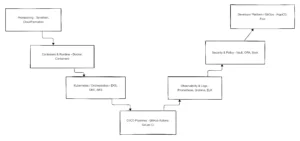

3. The DevOps Skill Stack (2026 Edition)
3.1 Linux & System Administration
Since over 90% of cloud servers run on Linux, DevOps engineers must understand:
- Linux file system & permissions
- Networking tools (curl, netcat, traceroute)
- Bash scripting for automation
- System monitoring (top, ps, netstat)
3.2 Networking & Security Basics
Over 70% of cloud outages originate from network misconfigurations. Learn:
- DNS, routing, load balancing
- Subnets, firewalls, gateways
- SSL/TLS fundamentals
- Zero Trust architectures
3.3 Programming for DevOps (Python/Go)
Python is ideal for automation and scripting, while Go powers modern cloud-native tools such as Kubernetes and Docker.
3.4 Git & Version Control
- Branches, merges, rebasing
- Pull request workflows
- Git hooks
- GitOps (ArgoCD, FluxCD)
3.5 CI/CD Pipelines
Core tools include GitHub Actions, GitLab CI, Jenkins, and CircleCI. Pipelines typically automate:
- Build
- Test
- Security scanning
- Deployment
- Notifications
3.6 Containers — Docker
Containers drive microservices adoption. DevOps engineers must know:
- Dockerfiles
- Multi-stage builds
- Image security
- Container networking
3.7 Kubernetes & Orchestration
Kubernetes is now used by over 75% of companies deploying cloud-native applications. Learn:
- Pods, Deployments, Services
- Ingress controllers
- ConfigMaps & Secrets
- Helm charts
- Autoscaling (HPA)
- Service Mesh (Istio, Linkerd)
3.8 Cloud Platforms
AWS leads with 31% global market share, followed by Azure and GCP. Focus on:
- Compute (EC2, Lambda)
- Storage (S3)
- Networking (VPC, Subnets)
- Monitoring (CloudWatch)
- Security (IAM)
3.9 Infrastructure as Code (IaC)
Terraform is the industry standard. Learn to define infrastructure declaratively, manage states, and implement reusable modules.
3.10 Observability — Monitoring & Logging
Top tools include Prometheus, Grafana, ELK Stack, Datadog, and New Relic.
3.11 DevSecOps
Security is integrated early. Tools include:
- Trivy
- Snyk
- SonarQube
- HashiCorp Vault
3.12 Soft Skills
DevOps engineers must excel in communication, documentation, problem-solving, and cross-team collaboration.
4. Step-by-Step DevOps Roadmap (Beginner → Advanced)
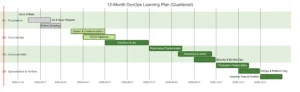

4.1 Phase 1 — Foundations (1–2 Months)
- Linux basics
- Networking fundamentals
- Git essentials
- Python or Go basics
4.2 Phase 2 — Core DevOps Skills (2–4 Months)
- CI/CD pipelines
- Docker & containerization
- Cloud fundamentals (preferably AWS)
- Terraform basics
4.3 Phase 3 — Advanced DevOps (4–8 Months)
- Kubernetes ecosystems
- Monitoring & alerting
- Advanced networking
- Security practices
4.4 Phase 4 — Specialization (10–12 Months)
- Site Reliability Engineering (SRE)
- Platform Engineering
- DevSecOps
- Cloud Architecture
5. Real Job Profiles & Tool Stacks (2026)
5.1 Junior DevOps Engineer
Focuses on CI/CD, deployments, basic monitoring, and cloud services.
5.2 DevOps Engineer
Manages Kubernetes clusters, CI/CD pipelines, monitoring tools, and automation frameworks.
5.3 Senior DevOps Engineer
Designs scalable cloud infrastructure, leads incident response, and optimizes cost and reliability.
5.4 Site Reliability Engineer
SREs define SLOs, SLIs, error budgets, and build automation for reliability.
5.5 Platform Engineer
Builds internal developer platforms (IDPs) and implements GitOps workflows.
6. Portfolio Projects That Make You Job-Ready
- CI/CD pipeline for a microservices app
- Kubernetes deployment for a 3-tier application
- Terraform-managed AWS environment
- Prometheus + Grafana monitoring stack
- GitOps deployment using ArgoCD
7. Interview Preparation & DevOps Hiring Trends
7.1 Sample Questions
- Explain CI vs CD vs Deployment.
- How does Kubernetes handle scaling?
- Describe a blue-green deployment strategy.
- What happens when you type a URL in a browser?
7.2 What Employers Look For
- Hands-on project experience
- Strong troubleshooting skills
- Understanding of reliability and scaling
- Clear communication
8. The Future of DevOps (2026–2030)
- AI-assisted operations (AIOps)
- GitOps-first deployments
- Zero Trust security
- Rise of platform engineering
9. Conclusion: DevOps Is a Continuous Journey
DevOps continues to evolve rapidly. Whether you aim to become an SRE, Cloud Engineer, Platform Engineer, or DevSecOps specialist, this roadmap gives you the foundation needed to thrive in a high-growth technology career.


