







Why Job Security Is a Myth
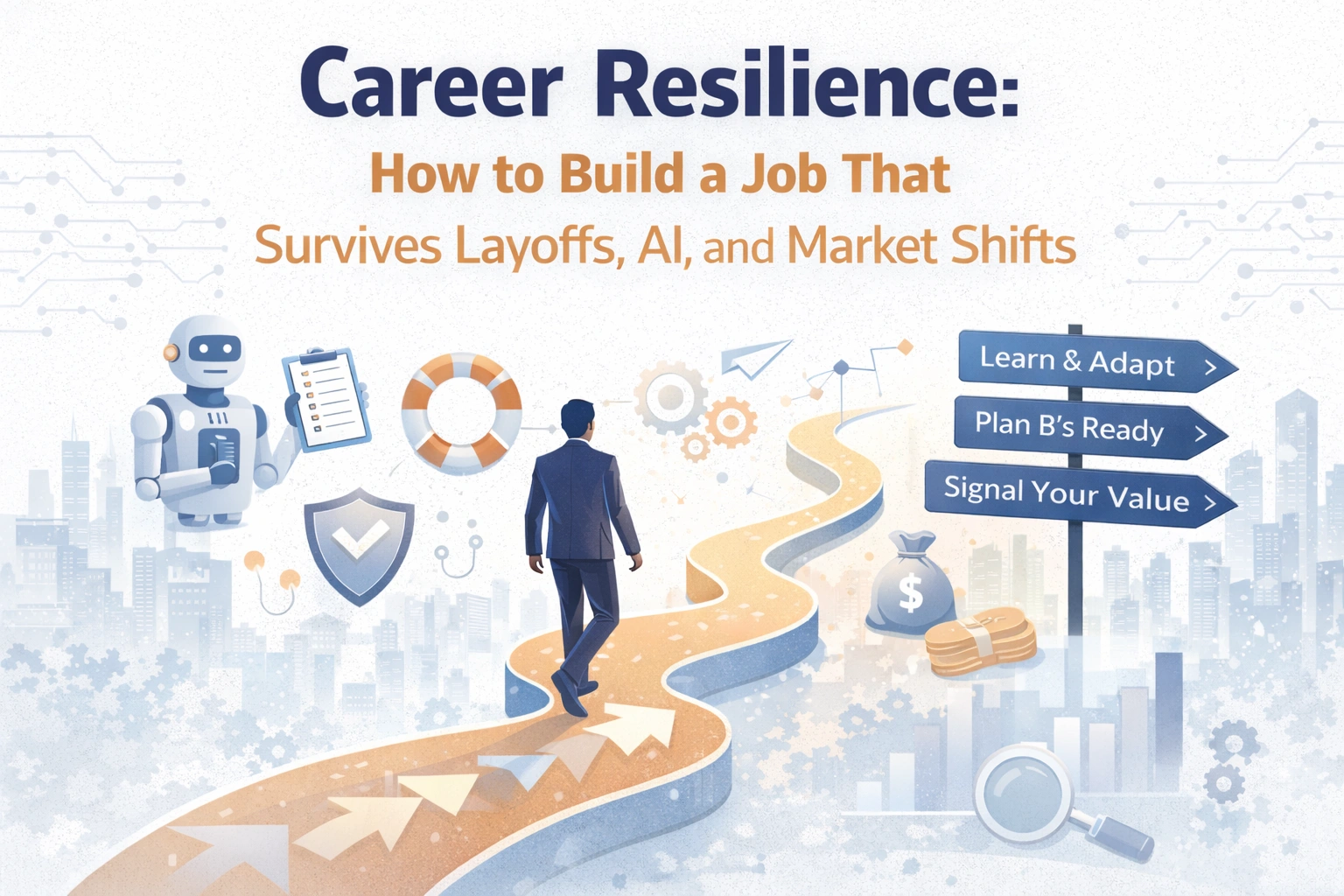
Job security used to be defined by tenure. Stay long enough, perform well, and stability would follow. In today’s economy, that promise has disappeared. Entire teams are eliminated while performance ratings remain strong, and layoffs increasingly reflect business restructuring rather than individual failure.
The uncomfortable truth is that no role is immune to disruption. Artificial intelligence, automation, outsourcing, and shifting business priorities mean that relying on a single employer or job title is inherently risky. Even highly skilled professionals can be caught off guard when strategy changes.
Career resilience is not about avoiding change or constantly switching jobs. It is about being prepared for disruption, recovering quickly when it happens, and continuing to move forward without panic or loss of momentum.
What Career Resilience Really Means
Career resilience is the ability to absorb professional shocks, adapt to changing conditions, and maintain forward progress even when roles disappear or industries shift. It is not about perfection or constant hustle, but about durability over time.
Resilient professionals invest in assets that compound across roles and companies. These include transferable skills, strong professional relationships, financial stability, and visible proof of value. When disruption occurs, these assets reduce recovery time dramatically.
Instead of asking whether their current job is safe, resilient professionals ask a more powerful question: how quickly could I recover and reposition myself if this role ended tomorrow?
The Five Pillars of Career Resilience
1. Skill Durability
Durable skills create value across industries, companies, and economic cycles. These are not narrow tool-based abilities, but outcome-driven capabilities such as problem solving, systems thinking, communication, data interpretation, and execution. Skills tied directly to business impact last longer than role-specific tasks.
Resilient professionals continuously evaluate whether their skills are aligned with what organizations are actively hiring and paying for. Comfort and familiarity are less important than relevance and applicability.
2. Role Optionality
Role optionality means qualifying for more than one role at a similar seniority level. When one role contracts or becomes automated, another becomes viable without starting a career over from scratch.
Optionality is built through transferable experience, not through collecting unrelated certifications. Professionals with optionality can pivot sideways instead of falling backward during disruption.
3. Network Strength
The majority of job opportunities never appear on public job boards. They move through referrals, internal mobility, and professional networks. A strong network significantly shortens job searches and reduces uncertainty during transitions.
Resilient networks are built before they are needed. Consistent, low-pressure interaction over time creates trust and keeps opportunities accessible when circumstances change.
4. Financial Runway
Financial stability provides clarity under pressure. Savings, manageable fixed expenses, and backup income options allow professionals to make strategic decisions instead of reactive ones.
A financial runway transforms layoffs from emergencies into temporary disruptions and expands the range of options available during transitions.
5. Personal Signal
Visibility determines opportunity. Professionals who document their work, share insights, or explain how problems were solved create signals that attract inbound interest from recruiters, peers, and decision-makers.
A strong personal signal accelerates recovery after disruption and increases leverage during negotiations.
AI-Proof vs AI-Resilient Careers
No career is completely AI-proof. The more realistic and sustainable goal is AI resilience. This means learning how to work alongside automation rather than competing with it.
Roles centered on judgment, context, creativity, coordination, and decision-making adapt better than roles focused solely on repetitive execution. Professionals who learn to leverage AI tools increase their output and relevance rather than being displaced.
In many cases, people are not replaced by AI itself, but by others who know how to use AI effectively within their role.
Early Warning Signals Before Layoffs
Layoffs rarely happen without warning. Hiring freezes, shifting performance metrics, leadership changes, reduced budgets, and declining investment in certain teams often appear months in advance.
Professionals who pay attention to these signals can begin strengthening skills, activating networks, and exploring options long before urgency sets in. Early awareness creates a strategic advantage.
How Resilient Professionals Respond Differently
When disruption occurs, resilient professionals respond with preparation rather than panic. They already have updated skills, active relationships, and a clear understanding of how their experience transfers to new contexts.
Their success during transitions is rarely the result of luck. It is the outcome of deliberate, long-term investment in resilience.
How to Audit Your Career for Risk
A career audit helps identify exposure before it becomes a problem. Assess skill demand, role flexibility, financial runway, network strength, and visibility to understand where you are resilient and where you are vulnerable.
Weak areas are not failures. They are priorities for focused improvement.
Career Resilience Checklist
Use the downloadable checklist accompanying this article to evaluate your current resilience across skills, roles, finances, network, and visibility. Regular reviews turn resilience into a repeatable habit rather than a one-time effort.
From Fear to Strategic Control
Career resilience shifts the conversation from fear to agency. When preparation replaces panic, change becomes manageable and often advantageous.
The most resilient careers are not built overnight. They are built deliberately through consistent skill investment, strong professional relationships, financial awareness, and visible proof of value over time.


