






Why Traditional Career Plans No Longer Work
For decades, career planning followed a predictable formula. People selected a profession early, entered a stable organization, progressed through defined roles, and expected steady advancement. This model relied on slow technological change, long product cycles, and clearly defined job descriptions.
That world no longer exists. Roles are redesigned faster than resumes can be updated, and entire functions can be restructured in a single quarter. What once felt like a safe career path can quickly become obsolete.
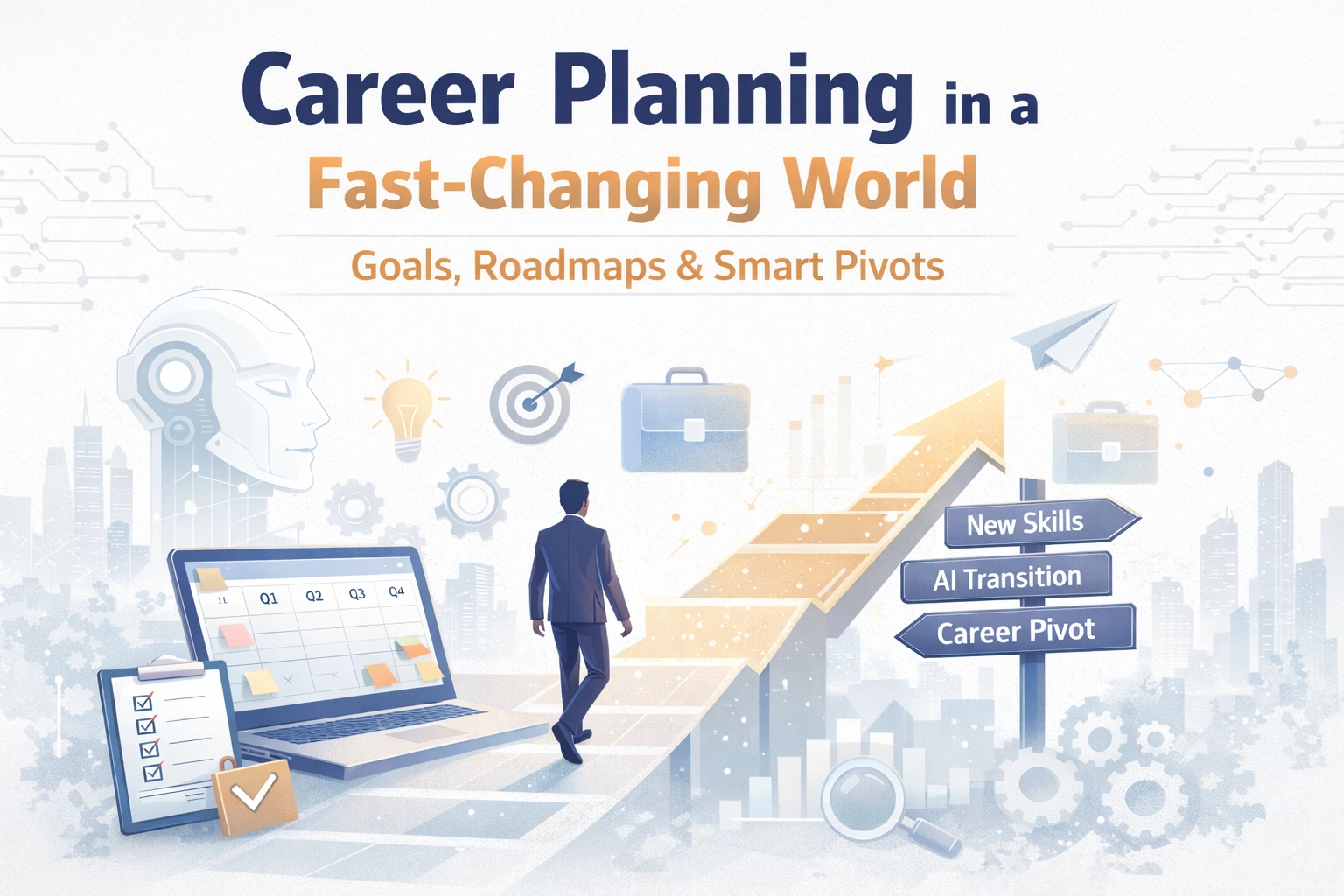
Modern career planning requires a shift in mindset. Instead of choosing the right job once, professionals must build adaptable systems that allow them to learn, pivot, and recover without losing momentum.
The New Realities of Work
Artificial intelligence, automation, and economic uncertainty are reshaping how work is created and valued. Many organizations are simplifying structures, removing middle layers, and prioritizing roles that directly impact revenue, efficiency, or product differentiation.
Layoffs are often described as AI-driven, but in practice, they usually reflect cost optimization and strategic realignment. The result for individuals is the same: reduced predictability and shorter decision windows.
In this environment, careers reward adaptability more than tenure. Those who can learn quickly, apply skills across contexts, and reposition themselves early gain a significant advantage.
Career Planning as a Continuous System
Treating a career as a fixed ladder creates fragility. A more effective model treats a career like a product or platform that evolves. Product teams do not plan five years in detail; they iterate, gather feedback, and adjust direction continuously.
A system-based career plan replaces rigid timelines with short cycles. Quarterly skill investments, six-month role experiments, and annual strategic reviews create flexibility while still compounding progress.
The objective is not to predict every future role accurately, but to remain positioned where opportunities emerge, and transitions feel manageable instead of disruptive.
Building a Resilient Career Roadmap
Vision and North Star
A career north star provides direction rather than a fixed destination. It helps prioritize opportunities and avoid distractions that do not contribute to long-term growth.
Effective north stars combine the value you enjoy creating, the domain you want to work in, and the role archetype you prefer. Reviewing this direction annually ensures it evolves alongside your interests and market realities.
Skills Architecture
High-value professionals develop T-shaped skill profiles, combining deep expertise in one area with supporting skills across adjacent domains. On top of this foundation sit meta-skills such as communication, learning speed, and decision-making.
This layered approach allows individuals to reposition themselves when roles change while preserving core values and credibility.
Portfolio Thinking
Relying on a single career path increases risk. Portfolio thinking encourages maintaining multiple potential role paths that share transferable skills.
Small experiments—side projects, internal initiatives, or short consulting engagements—provide real-world validation and reduce uncertainty before making major transitions.
Financial and Career Buffers
Flexibility depends on stability. Financial savings, monetizable skills, and strong professional relationships act as buffers that make transitions deliberate rather than reactive.
These buffers turn layoffs or role changes into temporary disruptions instead of long-term setbacks.
Networking and Internal Mobility
Many high-quality career moves occur through internal transfers or referrals rather than open job postings. Maintaining active relationships increases access to these opportunities.
Consistent, low-pressure engagement compounds over time and creates optionality when market conditions shift.
Smart Career Pivots
A pivot does not require abandoning experience. Most successful pivots redeploy existing skills into adjacent contexts where demand is growing.
Strategic pivots are usually triggered by stalled learning, declining demand signals, or the appearance of a stronger opportunity aligned with long-term direction.
Preparing for a pivot months in advance through skill development and experimentation dramatically increases success rates.
Learning Strategies That Actually Work
Passive learning rarely leads to meaningful career change. Applied learning—projects, real deliverables, and mentorship—creates proof of capability.
Short learning sprints focused on tangible outcomes help translate theory into practical leverage that employers recognize and reward.
Reading Employer Signals
Organizations signal future priorities through hiring patterns, product roadmaps, and investments in learning programs.
Monitoring these signals allows professionals to align skill development with future demand rather than reacting after roles disappear.
Real-World Career Examples
Across technology, marketing, operations, and product roles, individuals who plan with optionality pivot faster and recover more quickly from disruptions.
The common factor in these cases is preparation, not luck.
Career Planning Templates
Simple tools such as a 12-month roadmap, skills audit, and pivot checklist transform abstract planning into repeatable action.
Reviewing and adjusting these tools quarterly keeps plans aligned with real-world feedback.
SEO, Visibility, and Personal Brand Strategy
In a competitive job market, visibility creates opportunity. Publishing case studies, technical breakdowns, and thoughtful analysis helps professionals demonstrate impact and attract inbound interest.
Personal branding is most effective when it focuses on clarity and usefulness rather than promotion. Explaining how problems were solved builds trust faster than generic advice.
Content that answers specific questions performs well in both traditional search engines and AI-powered discovery tools.
Measuring Career Progress Without Burnout
Effective measurement focuses on outcomes rather than activity. Skill depth gained, projects shipped, and opportunities created provide clearer signals than hours worked.
Sustainable progress consistently outperforms short-term intensity. Treat your career as a long-distance journey supported by focused sprints and intentional recovery.
Conclusion
Career disruption is no longer an exception—it is a constant. Those who treat their careers as adaptable systems gain resilience and leverage.
By planning dynamically, learning continuously, and pivoting deliberately, professionals can turn uncertainty into a long-term advantage.


