







The Illusion of Titles and Promotions
For decades, career success was explained through a simple formula: get promoted, earn a better title, and everything else would follow. Seniority meant security. The manager meant authority. The director meant influence. But that mental model is increasingly disconnected from how modern careers actually work.
Today, job titles are cheap. Companies rename roles to attract talent, flatten hierarchies to reduce cost, and rebrand responsibilities without increasing authority or compensation. Two people with the same title can have wildly different levels of impact, autonomy, and future opportunity.
The professionals who continue to grow despite layoffs, reorganizations, and AI-driven change are not protected by titles. They are protected by something far more durable: career capital.
What Career Capital Really Is
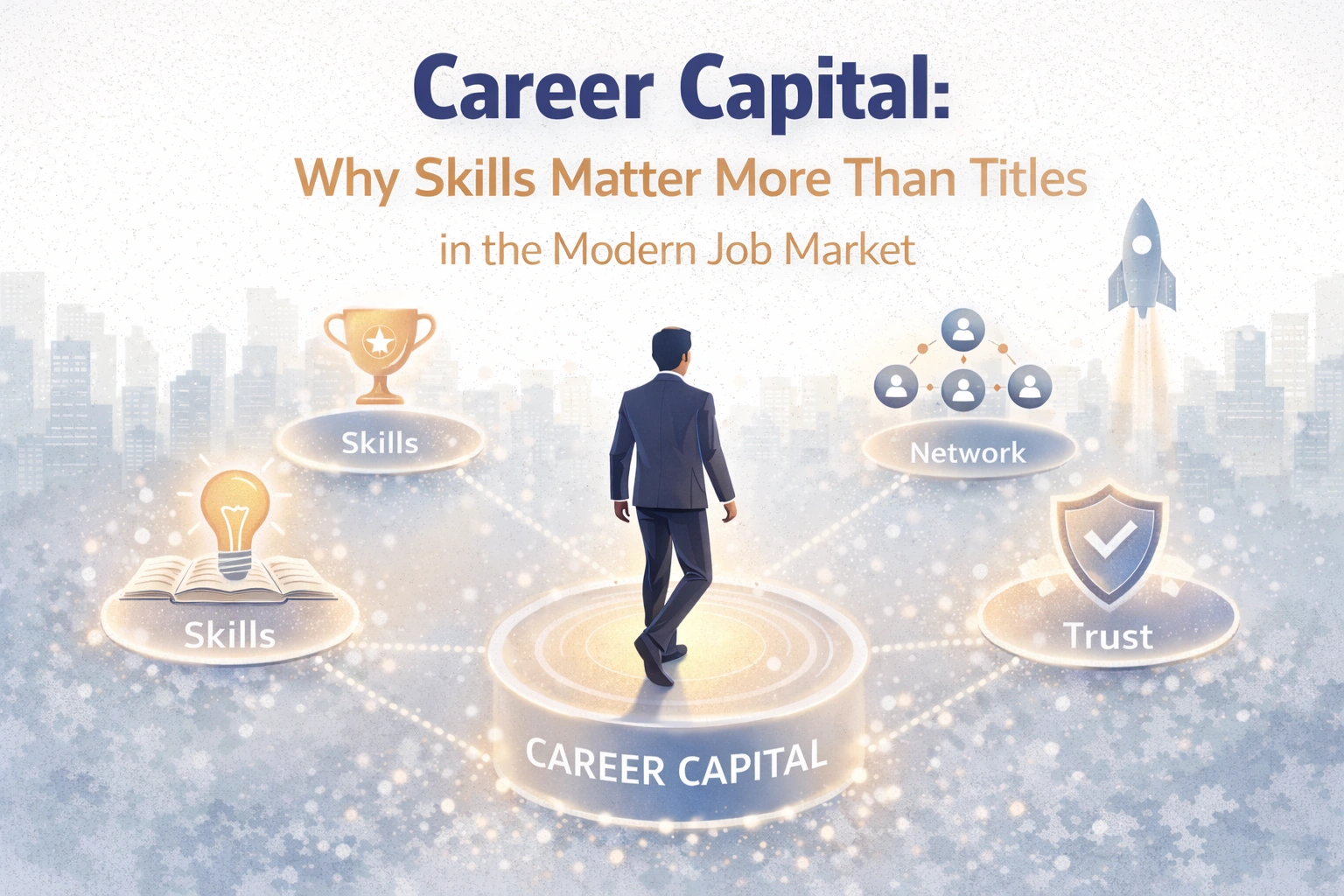
Career capital is the collection of skills, reputation, relationships, and proof that make you valuable across companies, industries, and market cycles. Unlike titles, it travels with you. Unlike resumes, it compounds.
When someone with strong career capital enters a new organization, they do not need long explanations. Their work speaks for them. Their network opens doors. Their skills create immediate leverage.
Career capital answers a far more important question than “What is your job title?” It answers “What problems can you reliably solve, and who trusts you to solve them?”
Why Skills Compound While Titles Expire
Titles are context-dependent. A “Head of Growth” at a startup may have less responsibility than a senior individual contributor at a large organization. When you leave a company, your title stays behind. Your skills do not.
Skills compound because they stack. A professional who learns data analysis, then applies it to marketing, then layers experimentation and strategy on top, becomes more valuable over time. Each skill increases the return on the others.
Titles, by contrast, reset. Every job change requires revalidation. Skills create momentum; titles require permission.
The Five Types of Career Capital
1. Skill Capital
Skill capital is the foundation. These are abilities that create measurable outcomes: shipping products, improving performance, increasing revenue, reducing risk, or simplifying complexity. The most valuable skills are not trendy tools but problem-solving capabilities.
Professionals with strong skill capital are often underestimated early in their careers because they focus on depth instead of optics. Over time, they become indispensable.
2. Reputation Capital
Reputation capital is what people say about you when you are not in the room. It is built slowly through reliability, judgment, and consistency. Reputation cannot be rushed, and it cannot be faked for long.
In moments of uncertainty, decision-makers rely on reputation more than resumes. Trust becomes a form of currency.
3. Network Capital
Network capital is not about collecting contacts. It is about relationships built on mutual respect and value. Strong networks shorten job searches, surface opportunities early, and provide perspective during transitions.
The most effective networks are maintained quietly over time, not activated only during crises.
4. Visibility Capital
Visibility capital determines whether your work is seen beyond your immediate role. Professionals who document outcomes, share insights, or teach others create public proof of value.
Visibility is not self-promotion. It is clarity. It ensures your contributions do not disappear inside systems.
5. Optionality Capital
Optionality capital is the ability to choose between multiple viable paths. It comes from transferable skills, financial runway, and credible alternatives.
Optionality reduces fear. When you are not dependent on a single outcome, you negotiate better and think more clearly.
How High Performers Actually Build Career Capital
High performers rarely chase promotions directly. Instead, they chase projects that stretch skills, increase exposure, and create tangible results. Promotions often follow as a side effect.
They choose work that compounds. A project that teaches system design is more valuable than one that merely fills time. A cross-functional initiative builds more capital than isolated execution.
Over time, these professionals accumulate proof. Not in the form of buzzwords, but in documented outcomes that transfer across roles.
Career Capital vs Hustle Culture
Hustle culture celebrates effort. Career capital rewards impact. Working longer hours does not automatically increase value. In many cases, it only increases burnout.
Career capital grows through leverage, not exhaustion. One well-chosen project can be worth more than a year of unfocused effort.
Real Career Capital Stories
Consider a mid-level engineer who spent years building internal tools that reduced operational complexity. When layoffs hit, their title did not protect them. Their work did. Multiple teams advocated for them because their impact was visible and transferable.
Another example is a marketing professional who quietly built analytics skills alongside campaign work. When budgets tightened, they pivoted into a growth analytics role without changing companies, because their skill capital already existed.
In both cases, career capital—not titles—created resilience and opportunity.
How to Audit Your Career Capital
A simple audit can reveal whether your career is built on titles or capital. Ask yourself: could I explain my value without mentioning my job title? Could I point to outcomes instead of responsibilities?
Gaps are not failures. They are signals. Career capital is built intentionally, not accidentally.
The 90-Day Career Capital Playbook
Over the next 90 days, focus on one skill that compounds, one project that creates proof, and one relationship that expands perspective. Document results. Share insights. Repeat.
Small, consistent investments outperform dramatic resets.
Playing the Long Game Most People Miss
Career capital is invisible early and undeniable later. It rewards patience, intentionality, and strategic thinking.
In a market where titles inflate and roles change constantly, career capital is what endures. Those who build it quietly gain freedom, leverage, and longevity that no promotion alone can provide.


