






Why Coding Agents Matter
Software development has long relied on incremental automation. Compilers translate human-readable syntax into machine instructions. Integrated development environments suggest variable names or highlight syntax errors. Static analysis tools flag bugs before code ever reaches production.
Yet all of these tools assume a human in control. Coding agents like Claude Opus 4.6 and GPT-5.3-Codex challenge that assumption.
These systems operate with agency. They interpret high-level goals, explore unfamiliar codebases, propose architectural changes, generate tests, run builds, and even submit pull requests. Instead of answering isolated prompts, they maintain continuity across long, multi-step tasks.
Earlier AI coding tools behaved like autocomplete engines. Today’s agents behave more like junior-to-mid-level engineers—sometimes fast, sometimes cautious, but increasingly capable of sustained independent work.
This shift has profound implications. Organizations can refactor legacy systems faster. Startups can ship with smaller teams. Individual developers can focus less on boilerplate and more on product thinking. At the same time, the technology raises unsettling questions about skill erosion, job displacement, and accountability when autonomous systems write production code.
A Rare Simultaneous Launch
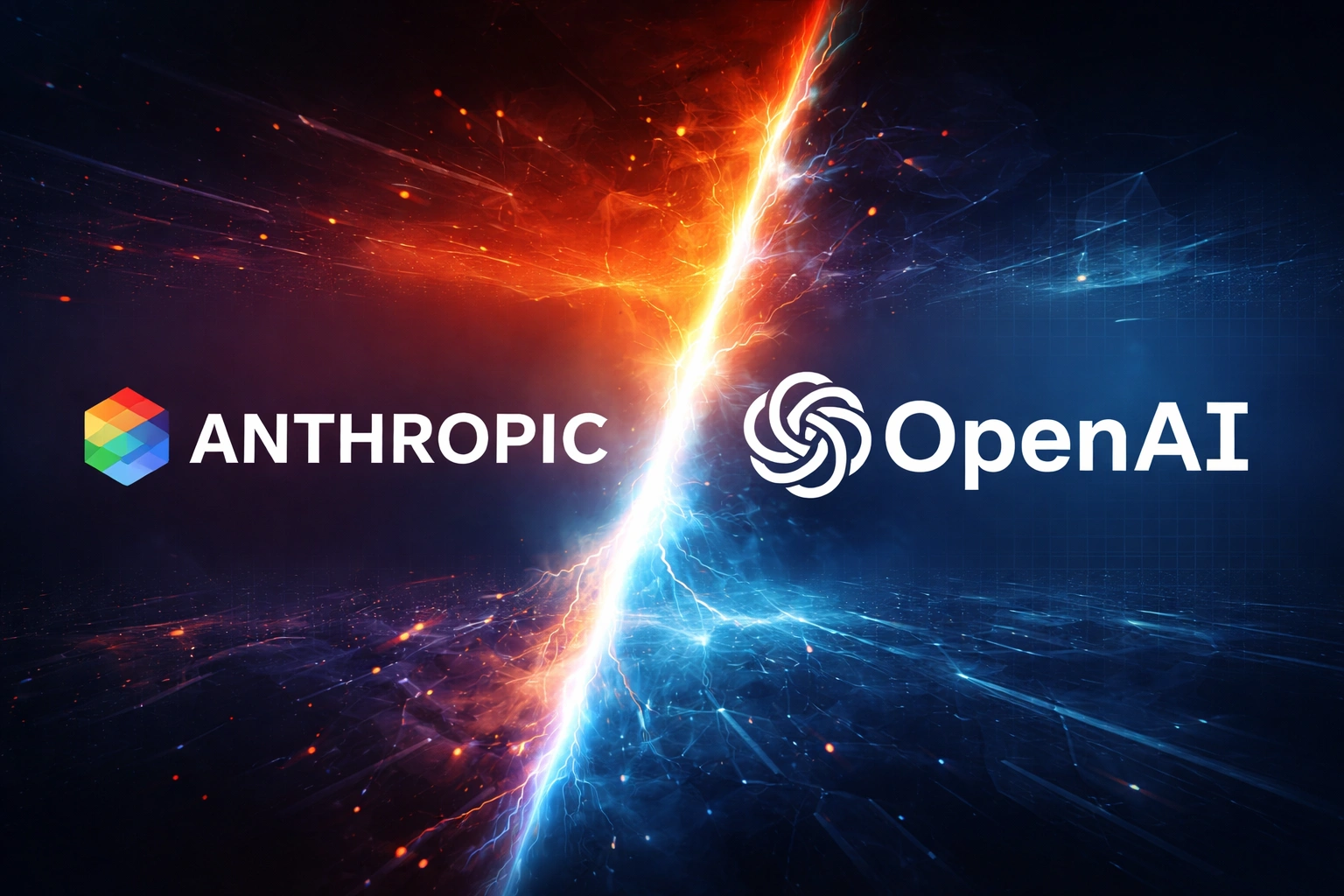
Anthropic and OpenAI dominate much of the conversation about frontier AI. Anthropic has cultivated a reputation for careful, safety-first development, while OpenAI has often pushed the envelope on raw capability and speed.
That both companies released major coding-agent updates on the same day was unusual—and telling. The timing underscored how central software engineering has become to the broader AI competition.
Developers immediately began comparing results, sharing screenshots, publishing benchmark numbers, and arguing about philosophy. Within hours, social media was filled with side-by-side comparisons, hot takes, and early verdicts—many of them contradictory.
Two Philosophies, One Goal
While Claude Opus 4.6 and GPT-5.3-Codex aim to solve similar problems, they embody different design philosophies that become apparent in daily use.
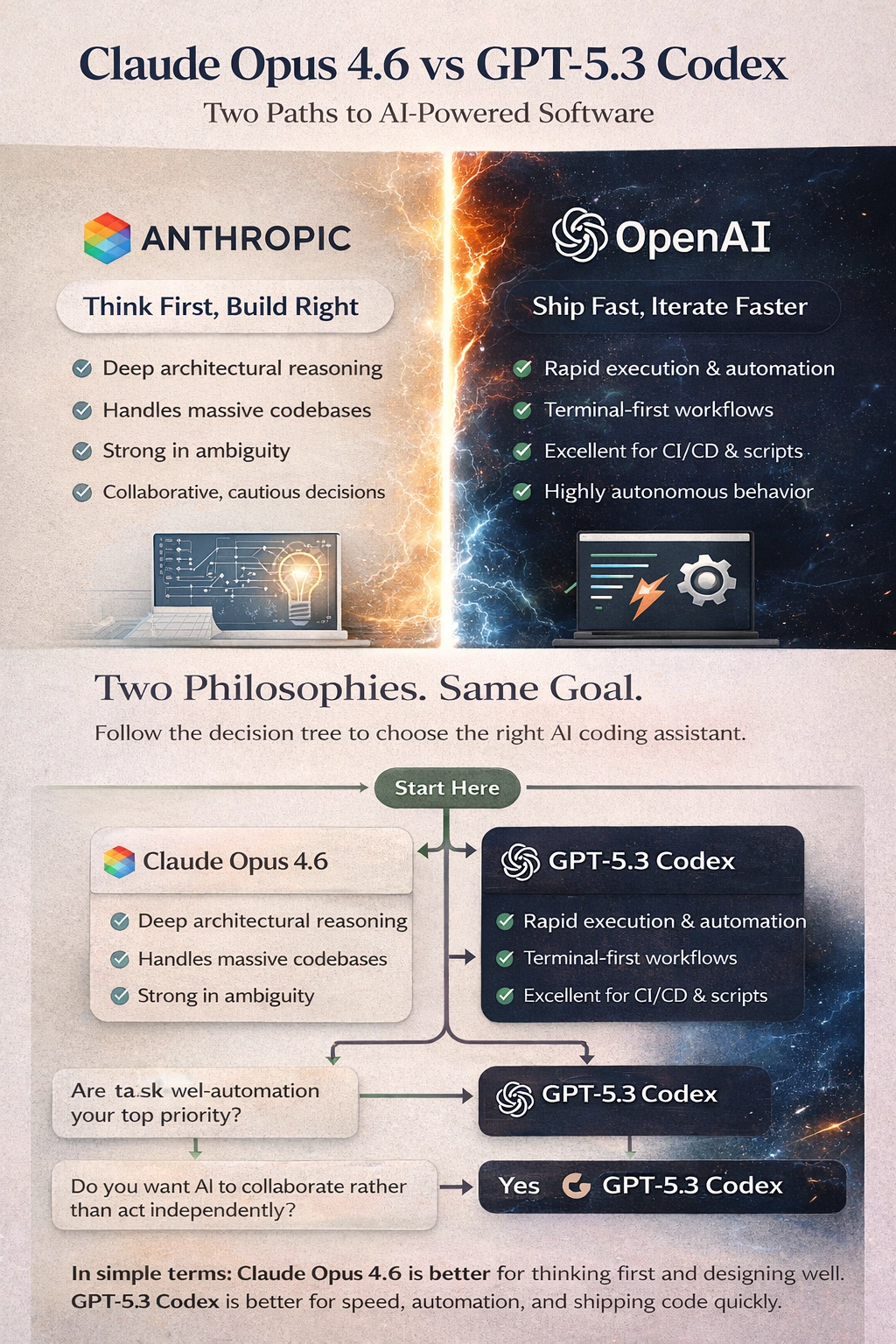

Both systems redefine how software is built — the difference lies in how much thinking versus execution you want from your AI.
Claude Opus 4.6: The Collaborative Architect
Claude Opus 4.6 represents Anthropic’s most capable model to date. It is optimized for long-context reasoning, ambiguity tolerance, and multi-agent collaboration.
With support for extremely large context windows, Opus can ingest entire repositories, architectural documents, and product requirements in a single session. Rather than rushing to produce code, it often pauses to clarify assumptions, surface trade-offs, and propose structured plans.
Developers testing Opus frequently describe it as thoughtful, methodical, and surprisingly conversational. It behaves less like a code generator and more like a senior engineer who insists on understanding the problem before committing to an implementation.
One of Opus’s standout features is its ability to coordinate multiple specialized agents—each focusing on a different part of a system, such as frontend, backend, testing, or documentation. This mirrors how large engineering teams divide work, and it allows the model to manage complexity in a more human-like way.
GPT-5.3-Codex: The Autonomous Executor
GPT-5.3-Codex takes a different approach. Built as an extension of OpenAI’s GPT-5 line, Codex is tuned for execution speed, automation, and independence.
In practical terms, Codex excels at terminal-based workflows. It rapidly writes scripts, runs tests, fixes errors, and iterates without requiring constant oversight. In benchmark environments designed to simulate real development tasks, Codex often completes objectives faster and with fewer interruptions.
Developers describe Codex as relentless. It moves quickly, makes assumptions confidently, and prioritizes forward momentum. In agile environments where speed matters more than architectural perfection, this behavior can feel transformative.
“Codex feels like the most productive colleague you’ve ever had,” one engineer said. “It’s fast, focused, and always shipping.”
What the Benchmarks Reveal—and What They Don’t
Benchmark scores quickly became ammunition in debates about which model leads the race. In terminal-heavy evaluations, GPT-5.3-Codex consistently outperformed Opus. In tasks involving graphical interfaces, long workflows, or high-context reasoning, Opus often held the advantage.
But benchmarks tell only part of the story. Real-world development is messy. Requirements change. Documentation is incomplete. Trade-offs matter. In these scenarios, developers report that qualitative differences between the models become more important than raw scores.
Codex thrives when tasks are well-defined and execution-heavy. Opus shines when ambiguity, architecture, and long-term maintainability come into play.
Inside Real Engineering Workflows
Several engineers have now tested both systems in production-like environments. One developer described using both agents to rebuild a marketing platform from scratch, generating dozens of pull requests over a single week.
The conclusion was not that one model replaced the other, but that they complemented different stages of the workflow. Opus was more effective during early planning and major refactors. Codex dominated during implementation, testing, and iterative cleanup.
This pattern suggests that the future of AI-assisted development may not be winner-takes-all. Instead, teams may adopt multiple agents, each optimized for a particular phase of the software lifecycle.
The Human Question
As coding agents grow more capable, developers are being forced to reconsider their own roles. If an AI can write, test, and deploy code, what remains uniquely human?
Many engineers argue that judgment, product sense, and ethical responsibility cannot be automated. Others worry that over-reliance on agents could erode foundational skills, leaving teams vulnerable when systems fail.
For now, most organizations are treating coding agents as accelerators rather than replacements. But the pace of progress suggests that this balance may shift faster than expected.
A Market War Beyond Technology
The competition between Anthropic and OpenAI extends beyond model performance. It is also a battle over trust, enterprise adoption, regulatory perception, and brand identity.
Anthropic emphasizes safety, interpretability, and controlled deployment. OpenAI emphasizes capability, scale, and rapid iteration. These narratives resonate differently with startups, governments, and large enterprises.
As AI systems take on more responsibility, these philosophical differences may matter as much as benchmark results.
Where This Leaves Us
In early 2026, there is no definitive winner in the coding agent race. Claude Opus 4.6 and GPT-5.3-Codex represent two viable visions of how AI can augment—or reshape—software engineering.
One prioritizes understanding, collaboration, and architectural coherence. The other prioritizes speed, autonomy, and execution. Both are advancing rapidly.
The more important question may not be which model leads today, but how developers, organizations, and society adapt to a future where writing software is no longer a uniquely human skill.
The age of the coding agent has arrived. What comes next will depend as much on human choices as on machine intelligence.
| Dimension | Claude Opus 4.6 (Anthropic) | GPT-5.3 Codex (OpenAI) |
|---|---|---|
| Core Philosophy | Thoughtful, collaborative, architecture-first | Fast, autonomous, execution-first |
| Primary Strength | Deep reasoning and long-context understanding | Rapid code execution and iteration |
| Best Use Cases | Large codebases, refactoring, system design, and ambiguous requirements | CI/CD tasks, scripting, testing, and well-defined engineering work |
| Context Handling | Extremely large context windows (entire repositories, docs, specs) | Strong context, optimized for task-focused sessions |
| Approach to Problems | Pauses to analyze, clarify assumptions, and propose plans | Acts quickly, makes assumptions, and iterates aggressively |
| Autonomy Style | Collaborative agent that seeks alignment | Highly autonomous agent that “gets things done.” |
| Architectural Thinking | Strong emphasis on maintainability and coherence | Secondary to speed and functional correctness |
| Terminal & Automation Tasks | Good, but more deliberate | Excellent; excels in terminal-driven workflows |
| Benchmark Performance | Strong in UI, workflow, and reasoning-heavy benchmarks | Strong in execution-heavy and terminal benchmarks |
| Error Handling | More cautious, explains trade-offs and risks | Faster retries, less explanation by default |
| Developer Experience | Feels like a senior engineer or technical architect | Feels like a hyper-productive engineer |
| Ideal Team Environment | Design-heavy teams, legacy modernization, platform engineering | Agile teams, startups, fast-release cycles |
| Risk Profile | Lower risk of architectural drift | Higher risk if left fully unsupervised |
| Human Oversight Needed | Moderate (strategic checkpoints) | Higher for production and architecture decisions |
| Overall Personality | Methodical, reflective, collaborative | Relentless, fast, execution-oriented |
In simple terms, Claude Opus 4.6 is better for planning, architecture, and large systems, while GPT-5.3 Codex is better for fast execution, automation, and shipping code quickly.


