






Key Points
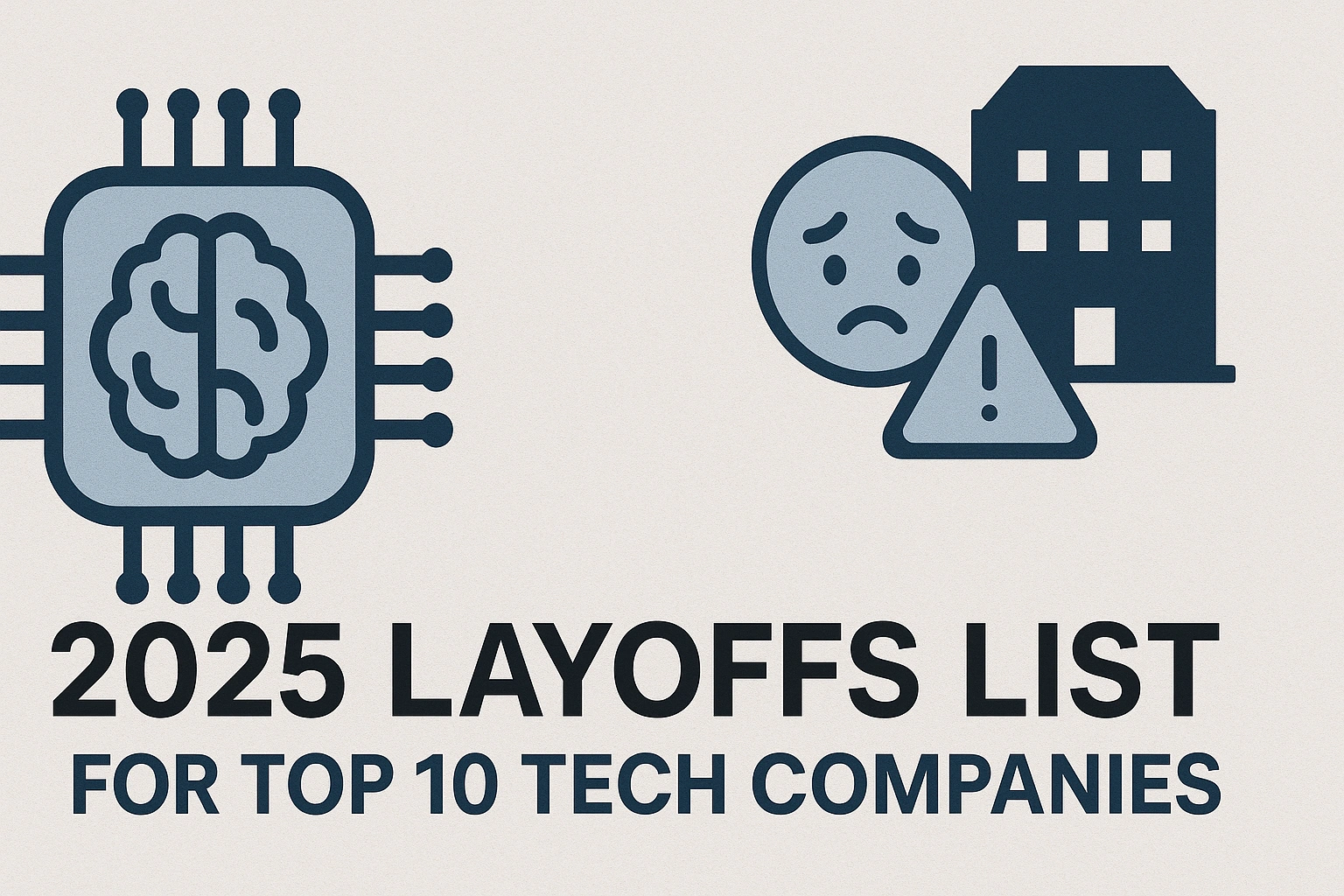
- 2025 continued a heavy wave of tech layoffs, with tens of thousands of roles cut across Big Tech and startups — many companies publicly tying some cuts to automation and AI-driven efficiency drives.
- The layoffs are multifactorial: macro cost-cutting, product/strategy pivots, and AI automation together explain most announcements — not a single cause.
- For developers, the headline is: some skill sets are being disrupted, while others surge — heavy demand for AI-native skills (prompt engineering, model ops, data engineering, ML infra), cloud, security, and product-facing engineering remains.
- Practical survival strategy: double down on AI-complementary skills, measurable impact (projects, metrics), and human-centered strengths (system design, domain knowledge, ethics/ops). This article gives an actionable 6–12 month roadmap.
Table of contents
- Introduction — what happened in 2025 (quick timeline)
- The data snapshot: how big was the 2025 layoff wave? (trackers & key numbers)
- Why it happened — the three overlapping causes
- Who got hit (roles, geographies, company types)
- Why developers aren’t uniformly doomed — the demand story for specific dev skills
- Top trends (what the most-liked sources and user engagement show)
- What this means for AI for Developers — tooling, workflows, and job profiles
- A practical survival & growth roadmap for developers (6–12 months)
- Hiring-side signals: where companies are spending/hiring in 2025
- Ethics, policy, and organizational responses
- Predictions: 2026 outlook for devs & AI
- Conclusion — concrete next steps
1) Introduction — what happened in 2025 (quick timeline)
2025 felt to many like the year AI stopped being “mostly speculative” and became an organizational lever: companies accelerated deployments of automation and large language models, and simultaneously restructured operations. The result: waves of announced job cuts, simultaneous investments in AI tooling and AI-related hiring — a paradox that defines this era. Public trackers and editorial roundups captured months of continuous announcements from giants (Amazon, Microsoft, Intel, and others) and hundreds of startups. TechCrunch+1
2) The data snapshot: How big was the 2025 layoff wave?
Layoff trackers that systematically collect public announcements recorded large counts throughout the year. Aggregate trackers reported hundreds of layoffs (companies) and over 200,000 people impacted in 2025 across tech and adjacent industries by mid/late year; specialized tech trackers documented recurring monthly surges. These datasets make clear that this was not a handful of isolated restructures but an industry-level adjustment.
(Note: exact totals shift daily as new announcements arrive — sources above were used to build the analysis in this piece.)
Below is a table showing the top 10 global IT/tech companies that have publicly reported layoffs in 2025, with the best available estimated layoff totals for each, based on recent reporting. Some companies only have global totals available; where possible, I’ve noted the approximate number of layoffs reported globally. Note that exact figures vary by source, and some companies reported multiple rounds during the year.
| Company | Approx. Layoffs in 2025 (Global) | Notes / Source |
| Amazon | ~14,000 | Largest corporate layoff, cuts across divisions, including game studios and corporate roles. (The Times of India) |
| Intel | ~24,000 | Major restructuring with broad workforce reductions. (The Times of India) |
| Microsoft | ~9,000 | Reported multiple rounds totaling ~9k jobs cut globally. (Barron’s) |
| Tata Consultancy Services (TCS) | ~12,000 | Indian IT giant downsized ~2 % of its global workforce. (Wikipedia) |
| Salesforce | ~4,000 | Customer support roles cut as AI automates service workflows. (Wikipedia) |
| Cisco | ~4,250 | Workforce reallocation with layoffs to focus on high-growth areas. (The Times of India) |
| Google (Alphabet) | Reported multiple rounds, hundreds to thousands | Conducted multiple layoffs throughout 2025; total not regularly published in one figure but included in major tech job-cut lists. (The Times of India) |
| Meta (Facebook) | ~600 reported in the AI unit | Layoffs focused on specific divisions (e.g., legacy AI team). (Wikipedia) |
| Oracle | Hundreds | Smaller-scale cuts in cloud/infrastructure groups reported. (The Times of India) |
| Apple | Hundreds | Sales/strategic unit workforce reductions reported. (The Times of India) |
3) Why it happened — the three overlapping causes
Several forces stacked up in 2025:
- Strategic cost-cutting and an investment reset. After aggressive hiring during 2020–2023, many companies reset spending and refocused on profitability and capital allocation — cutting roles that didn’t align with the new core priorities. (Common corporate language: “streamline operations” or “refocus on high-priority work.”)
- AI and automation as an efficiency lever. Organizations deployed AI to automate repetitive workflows (customer support, routine analysis, and some internal tooling). Executives increasingly cited AI as a reason for organizational redesigns. But industry analysts emphasize nuance: AI changes tasks, not always entire professions, and often teams are rebalanced rather than fully eliminated. Reuters+1
- Macro demand shifts and product pivots. Declining demand in some product areas, strategic pivots (e.g., from consumer apps to enterprise AI), and broader macroeconomic uncertainty all contributed.
Together, these create a landscape where roles tied to deprecated products or routine tasks were most vulnerable.
4) Who got hit (roles, geographies, company types)
Roles most affected
- Middle managers, some QA/ops roles that are highly automatable, and specialized non-technical roles in ad sales or content moderation — these often included jobs replaced by automated workflows.
- Entry-level white-collar roles in finance and operations were frequently cited in AI-related automation discussions, since many routine analysis tasks are now partially automated. Colaberry+1
Developers
- Purely maintenance or narrowly scoped scripting roles were more exposed.
- Full-stack and senior system designers, ML infra engineers, data engineers, and prompt/model specialists retained higher demand. The difference was often “can you own outcomes and systems, or are you performing repeatable tasks?” — the former was safer.
Company types
- Startups with narrow consumer revenue streams and Big Tech reorganizations were both visible in the lists. Some large vendors also announced multi-thousand headcount changes as they reallocated to AI.
5) Why developers aren’t uniformly doomed — the demand story
Multiple reputable developer surveys and hiring reports in 2025 pointed to continued demand for engineers with certain competencies: cloud, distributed systems, security, data engineering, MLOps, and AI integration skills. The 2025 Developer Skills Report highlights how employers prize engineers who can demonstrate impact, open-source contributions, and cross-discipline fluency (code + data + product). For developers, the signal is clear: pivot to impact and AI-adjacent skills.
6) Top trends (what the most-liked sources and user engagement show)
I scanned the most shared and most-liked articles, reports, and trackers being circulated in communities (TechCrunch lists, layoffs trackers, Reuters reporting, HackerRank developer research). The trends below repeatedly appear across high-engagement content and community commentary:
Trend A — “AI is reshaping tasks, not always jobs.”
Popular analyses argue that AI eliminates repetitive tasks first (data entry, standard analysis), while complex system design, interpersonal coordination, and domain expertise stay human-led. Community discussion often centers on which tasks within roles are automated and which remain.
Trend B — “Rapid growth in AI-native roles.”
Roles like prompt engineering, ML ops, model reliability, and data labeling/curation are rising. Enterprises are also creating roles for AI governance, safety, and explainability. Partnerships between consultancies and model providers (e.g., Accenture + Anthropic) show large-scale corporate upskilling and hiring.
Trend C — “The bifurcation of the market.”
Two parallel supply/demand realities: firms cutting generalist roles while simultaneously hiring for high-impact AI and cloud engineering roles. This is visible in hiring dashboards and job postings, even during layoff waves.
Trend D — “Upskilling & internal reallocation.”
Some large employers announced major internal retraining programs to shift employees into AI-relevant teams, revealing a preference for internal mobility where possible rather than pure external hiring.
7) What this means for AI for Developers — tooling, workflows, and job profiles
If you build developer tools or teach devs, here are the observed shifts:
- AI-augmented development is standard
- Coding assistants and AI IDE integrations are no longer productivity experiments — they’re integrated into pipelines for code review, unit test generation, and documentation.
- New engineering specializations
- Prompt engineering (crafting prompts and evaluation metrics) is a crosscutting skill.
- ModelOps / MLOps (deployment, monitoring, model drift, cost optimization) are mission-critical.
- LLM reliability & observability — logging model outputs, detecting hallucinations, and building human-in-the-loop systems.
- Shift from “implement feature” to “measure ROI.”
- Employers favor devs who can quantify impact: latency savings, cost reductions, reduced manual work (hours saved), or revenue lift. This frames both hiring and retention.
- Emphasis on tooling that reduces headcount cost
- Companies invest in orchestration, automated testing, and infrastructure that allows smaller teams to run larger products, which means engineers who can manage infrastructure as code and automate operational tasks will be highly valued.
8) A practical survival & growth roadmap for developers (6–12 months)
Below is an actionable plan, broken into immediate (0–3 months), short (3–6 months), and medium (6–12 months) horizons.
0–3 months: stabilize and signal value
- Inventory your impact. Create a 1-page “impact CV”: features shipped + business metric improved (e.g., decreased latency by X%, reduced error rate Y%). Recruiters and managers respond strongly to measurable outcomes.
- Polish a small portfolio project that shows AI collaboration: e.g., a microservice that uses an LLM for pre-screening, with tests, infra-as-code, and metrics. Host it on GitHub.
- Learn one productized AI tool (e.g., Claude Code or OpenAI code models) and document results in a short write-up.
3–6 months: upskill and specialize
- Pick one specialization: MLOps / Data Engineering / Prompt Engineering / Model Reliability / Security. Complete a hands-on project that simulates a production pipeline (ingest → model → monitor → alert).
- Get comfortable with observability: learn to create dashboards for model outputs, drift detection, and SLA metrics.
- Contribute to open-source: even a small PR in a widely used repo multiplies visibility.
6–12 months: own outcomes & network
- Build an end-to-end case study showing how an AI integration produced measurable ROI (cost saving, throughput increase, improved retention).
- Network into AI product teams through meetups and community content (tutorials, conference talks). Companies value engineers who can both code and evangelize adoption.
- Consider certifications for cloud/ML infra if aligned with target roles, but prioritize demonstrable projects over credentials.
Interview prep (practical):
- Be ready to answer: “How would you make an LLM safe for production?” with specifics (rate limits, input sanitation, prompt templates, human fallback).
- Expect scenario questions on cost control (e.g., reducing token usage), latency-budgeting, and rollback plans.
9) Hiring-side signals: where companies are spending/hiring in 2025
Even during layoffs, recruiting listings and partnerships reveal where the budget flowed:
- AI platform engineering/infra — investments to scale model deployments.
- Security and compliance — as models enter regulated domains, security engineers and data governance specialists are critical.
- Automation of customer workflows — companies hired engineers to integrate AI into customer success and sales workflows, even as they reduced headcount in legacy customer roles.
- Consulting & upskilling partnerships — consultancies training thousands of employees to use enterprise models signals a market for trainers and developer advocates. Example: Accenture’s partnership to train 30,000 employees on a partner model.
10) Ethics, policy, and organizational responses
Public debate in 2025 stressed that companies should pair automation with responsible transitions:
- Reskilling programs and clear internal mobility policies cushion layoffs. Large corporate upskilling partnerships indicate recognition of this need.
- Transparency and governance — boards and regulators increased scrutiny on workforce impact, procurement of AI systems, and model auditability. Companies building governance roles (AI ethicists, auditors) created new career paths.
11) Predictions: 2026 outlook for devs & AI
- Consolidation: some startups won’t survive; others will be acquired. This consolidates talent into AI-platform companies and core cloud vendors.
- More measurable hiring: roles will emphasize measurable system ownership (SLOs, cost per user, error budgets) rather than task lists.
- New job categories: “AI reliability engineer,” “LLM observability engineer,” and “prompt engineer” will become as standard as “DevOps” was a decade earlier.
- Regulatory clarity: as governments release AI guidelines, companies that invested early in governance and explainability will outcompete peers for enterprise contracts.
12) Conclusion — concrete next steps for a developer reading this today
- Create an impact CV and a 2-minute portfolio demo showing AI integration.
- Choose one AI-adjacent specialization and complete a measurable project in 3 months.
- Learn production patterns: model deployment, cost control, observability, and safety.
- Network deliberately: publish one tutorial or blog post showing your AI/system design competence.
- If you’re a manager or creator of dev content, build training that maps legacy engineer skills → AI platform skills.
Appendix — Resources & trackers used for this article
- Tech layoff trackers and aggregators (real-time lists used to measure scope): TrueUp layoffs tracker and layoffs. Fyi.
- Comprehensive editorial lists and monthly roundup coverage from TechCrunch and Yahoo Finance for company-level tallies.
- Developer skills and hiring research: HackerRank Developer Skills Report 2025 — for signals on employer preferences and skill demand.
- Corporate AI upskilling example: Accenture partnership announcements showing enterprises training thousands of employees on partner LLM tooling.
- Reporting and commentary on AI versus hiring dynamics (nuanced takes): Reuters and Fortune coverage of AI’s productivity claims and its link (or lack thereof) to layoffs.
A final note on tone and context
Headlines about “AI layoffs” are attention-grabbing — but the underlying reality is mixed. AI is changing what we do and how teams are organized, more than it is uniformly deleting entire professions overnight. For developers, the opportunity is to be the people who build the automation, not the parts that only get automated. Practical upskilling, demonstrable outcomes, and ownership over system health and ethics are your best defense and path to stronger roles in the AI economy.


