
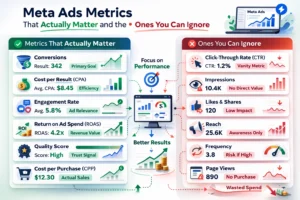







But in today’s Meta Ads environment, clarity comes not from watching everything, but from watching the right things.
The platform has evolved. What mattered five years ago does not always matter now. And understanding which metrics reflect true learning — versus surface noise — is one of the most important skills an advertiser can develop.
Why CTR Is No Longer King
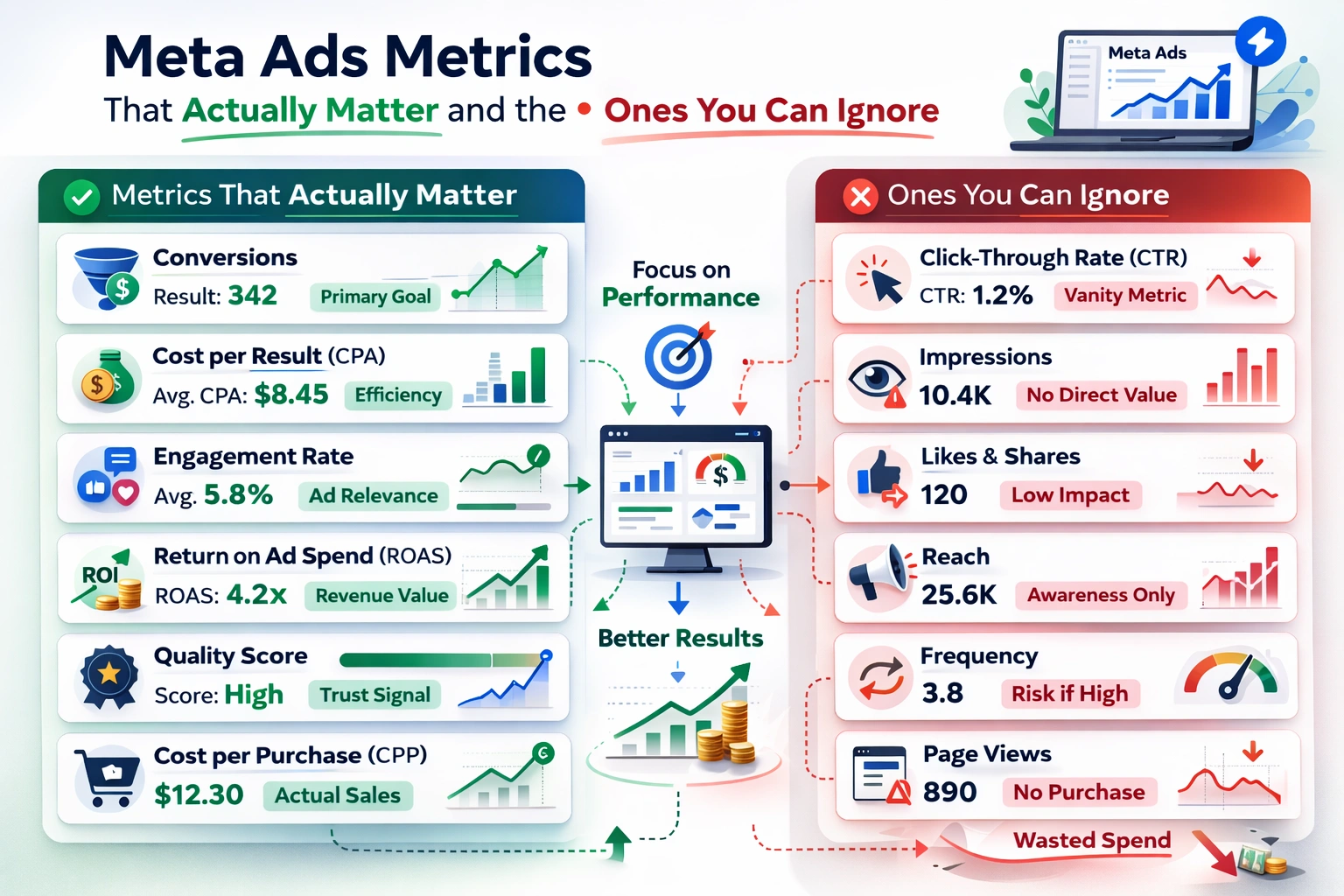
Click-through rate was once treated as the ultimate signal of ad relevance. A higher CTR meant better targeting, better creative, better everything. But CTR measures only a moment — the click itself — not what happens afterward.
A campaign can have a high CTR and still perform poorly if users bounce immediately or fail to convert. In contrast, a lower CTR campaign can outperform if the clicks it generates are intentional and engaged.
Meta’s algorithm increasingly evaluates deeper engagement patterns. This aligns with the broader shift where Meta Ads now prioritize signals over targeting, focusing on meaningful behavior rather than raw activity.
Metrics That Reflect Real Learning
Time on page, scroll depth, video watch percentage, and conversion rate often reveal more than clicks alone. These metrics indicate whether the user experience matches the promise of the creative.
Cost per result, when paired with stable delivery, is also meaningful. It reflects how efficiently the system is matching your message with receptive users.
Consistency matters too. Sudden volatility in performance can indicate weak signals or interrupted learning.
Frequency: A Misunderstood Signal
Frequency often triggers panic. When it rises, advertisers assume audiences are exhausted. But frequency alone does not indicate fatigue. Engagement decline does.
If users continue interacting despite a higher frequency, the creative is still resonating. If engagement drops sharply, the system may be signaling creative fatigue.
Watching engagement trends alongside frequency provides clearer insight than frequency alone.
CPM Is Not a Performance Score
Cost per thousand impressions reflects auction competition, not effectiveness. A rising CPM does not automatically mean a failing campaign. It may reflect seasonal demand, competitive bidding, or platform-wide shifts.
Evaluating CPM in isolation leads to unnecessary optimization changes. It becomes meaningful only when paired with downstream results.
Conversion Rate: The Quiet Indicator
Conversion rate often tells the most honest story. It reflects alignment between the audience, creative, and landing experience.
If the conversion rate remains stable while other metrics fluctuate, the core system is working. If it declines steadily, the issue may lie in message clarity or user experience rather than targeting.
Why Over-Optimization Disrupts Learning
One of the most common mistakes advertisers make is reacting too quickly to minor fluctuations. Small performance swings are natural. Constant adjustments reset learning and introduce instability.
The algorithm works best when given consistent data. Over-optimization fragments signal flow and weakens pattern recognition.
Patience, when guided by meaningful metrics, is often more powerful than constant tweaking.
A Simpler Dashboard Mindset
Instead of tracking dozens of columns, focus on a core set: cost per result, conversion rate, engagement quality, and delivery stability. These metrics reflect how well the algorithm is learning and matching your message.
Everything else provides context, not direction.
Meta Ads performance improves not when you monitor more numbers, but when you understand which numbers represent real signal strength.
The Takeaway
Metrics are tools, not answers. The goal is not to react to every fluctuation, but to interpret patterns over time.
When you focus on engagement depth, conversion alignment, and stable learning, you make decisions that cooperate with the algorithm rather than interrupt it.
In modern Meta Ads, wisdom beats volume.


