


Introduction — Why AI Overviews Break Old Link Assumptions
Search in 2026 is dominated by AI-generated answer units and AI Overviews that synthesize multiple sources into concise, user-facing summaries. These systems don’t treat links as isolated votes — they use them as semantic citation anchors that validate entity claims, reduce hallucination risk, and influence whether a domain will be surfaced in an AI answer.
For advanced SEOs, this shift means link building is now a strategic investment in entity authority and semantic trust, not merely a way to pump PageRank. Choosing the right link-building partner requires new evaluation criteria: editorial legitimacy, semantic alignment, outreach authenticity, and demonstrable influence on AI citations.
The Evolution of Link Value
From PageRank to Neural Semantic Trust
The old signals — PageRank, follow/nofollow, anchor text — still matter, but they are only part of a multi-layered trust model now influenced by entity graphs, vector proximity, and AI citation stability.
What Modern Link Value Looks Like
- Entity reinforcement: Links that tie content to a brand entity across trusted domains.
- Semantic cohesion: Links embedded in tightly relevant, topically deep content.
- Editorial trust: Mentions and citations in journalistic or research-driven contexts.
- Multimodal fitness: Citations that map across text, images, and structured data.
Why AI Overviews Matter
When an AI Overview synthesizes answers, it favors sources that reduce uncertainty — authoritative editorial pieces, corroborated data, and materials that map cleanly to an entity’s claims. For link builders, this elevates the value of editorial placements dramatically. It’s not about raw volume; it’s about being the source that AI considers trustworthy and cites when forming an answer.
Advanced Framework: 6 Pillars to Evaluate Link Building Partners
Below is a vendor evaluation framework tailored for advanced SEOs. Use it as a checklist and scoring rubric when assessing proposals and case studies.
Pillar 1 — Editorial Quality & Source Credibility
Ask vendors to provide real editorial placements (not guest-posts with hidden payments). You want third-party journalism, industry publications, or research citations — placements that AI models are already using as stable sources.
Pillar 2 — Outreach Process & Authenticity
Top vendors show evidence of customized pitches, journalist relationships, and newsworthy hooks. Beware of “guaranteed placements” or identical templates sent to hundreds of journalists.
Pillar 3 — Vendor Authority Signals
If a link-building company cannot rank for specialized SEO queries or appear in AI Overviews themselves, their claims deserve skepticism. Their own editorial footprint is a good proxy for their expertise.
Pillar 4 — Relevance & Semantic Alignment
The place where a link appears is as important as the page that links. Semantic cohesion — topic match, intent alignment, and context — is a multiplier for value.
Pillar 5 — Reporting & Measurement
Good vendors provide URL-level reporting, context, indexation checks, and signals around entity growth. If reporting is just a list of domain DRs and screenshots, it’s insufficient.
Pillar 6 — Ethics & Long-Term Viability
With AI-based anti-spam mechanisms increasing, unethical tactics create long-term risk. Avoid PBNs, paid link farms, or opaque networks.
Comparison: Weak Vendor vs Strong Vendor
| Factor | Weak Vendor | Strong Vendor |
|---|---|---|
| Placement Quality | Sponsored posts & content mills | True editorial articles & research citations |
| Relevance | Generic niche match | High semantic & intent alignment |
| Outreach | Bulk templates | Custom journalist angles & data hooks |
| Transparency | Opaque reporting | URL-level, context-rich reporting |
| Ethics | Paid networks, PBNs | Editorial-first, PR-rooted campaigns |
Scoring Workbook — Practical Vendor Evaluation
Use this quick scoring template. Each criterion scored 1–10; multiply by the weight to get a normalized vendor score.
| Category | Weight | Score (1–10) | Weighted Value |
|---|---|---|---|
| Editorial Quality | 25% | 8 | 2.0 |
| Relevance & Semantics | 20% | 9 | 1.8 |
| Outreach Authenticity | 15% | 7 | 1.05 |
| AI Overview Influence | 15% | 6 | 0.9 |
| Reporting Transparency | 10% | 8 | 0.8 |
| Vendor Authority | 10% | 7 | 0.7 |
| Ethics & Safety | 5% | 10 | 0.5 |
| Total | 7.75 / 10 |
Practical Tactics That Move the Needle
Top vendors in 2026 combine several tactical vectors:
- Data-driven journalism: proprietary studies, original data, and visualizations that journalists use as sources.
- Expert roundups & contributed insight: unique takes from credible authors, not repurposed content.
- Research & surveys: statistically defensible studies that earn citations.
- Thought leadership & long-form explainers: content so authoritative it’s referenced in AI Overviews.
- Entity network building: consistent brand mentions across trusted sites and author profiles.
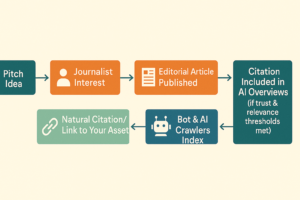
Flow Diagram: How a Quality Editorial Link is Earned
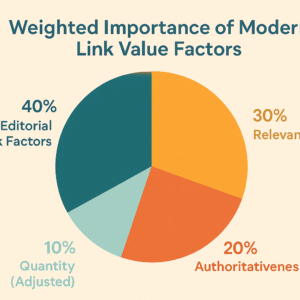
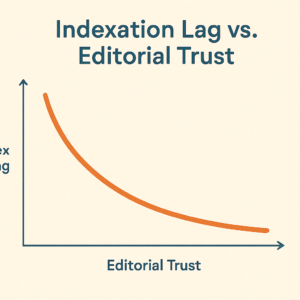
Charts — Visualizing Impact
Practical Example: What to Ask in a Vendor RFP
- Show three editorial links in relevant industry publications from the last 12 months (provide URLs and context).
- Demonstrate one case where your placement contributed to a page being cited by an AI Overview (screenshots + crawl timestamps acceptable).
- Describe your outreach workflow (pitch, follow-up cadence, journalist relationships).
- Provide a sample report with URL-level data and how you measure entity growth.
- List ethics guardrails (no PBNs, no link exchanges, disclosure of paid relationships).
Checklist: Red Flags & Green Flags
- Green: Editorial placements, thought leadership, unique data.
- Green: Transparent reporting, documented indexation proof.
- Red: Package deals of “X links/month” with no URL transparency.
- Red: PBNs, private networks, paid link farms.
Conclusion — The Long View
AI Overviews changed the game: links are now citation anchors inside an AI-driven semantic web. Choose partners who earn editorial citations, can demonstrate influence on AI surfaces, and prioritize entity-level authority. That’s how you future-proof organic visibility in a world where AI synthesizes answers instead of just ranking URLs.
