






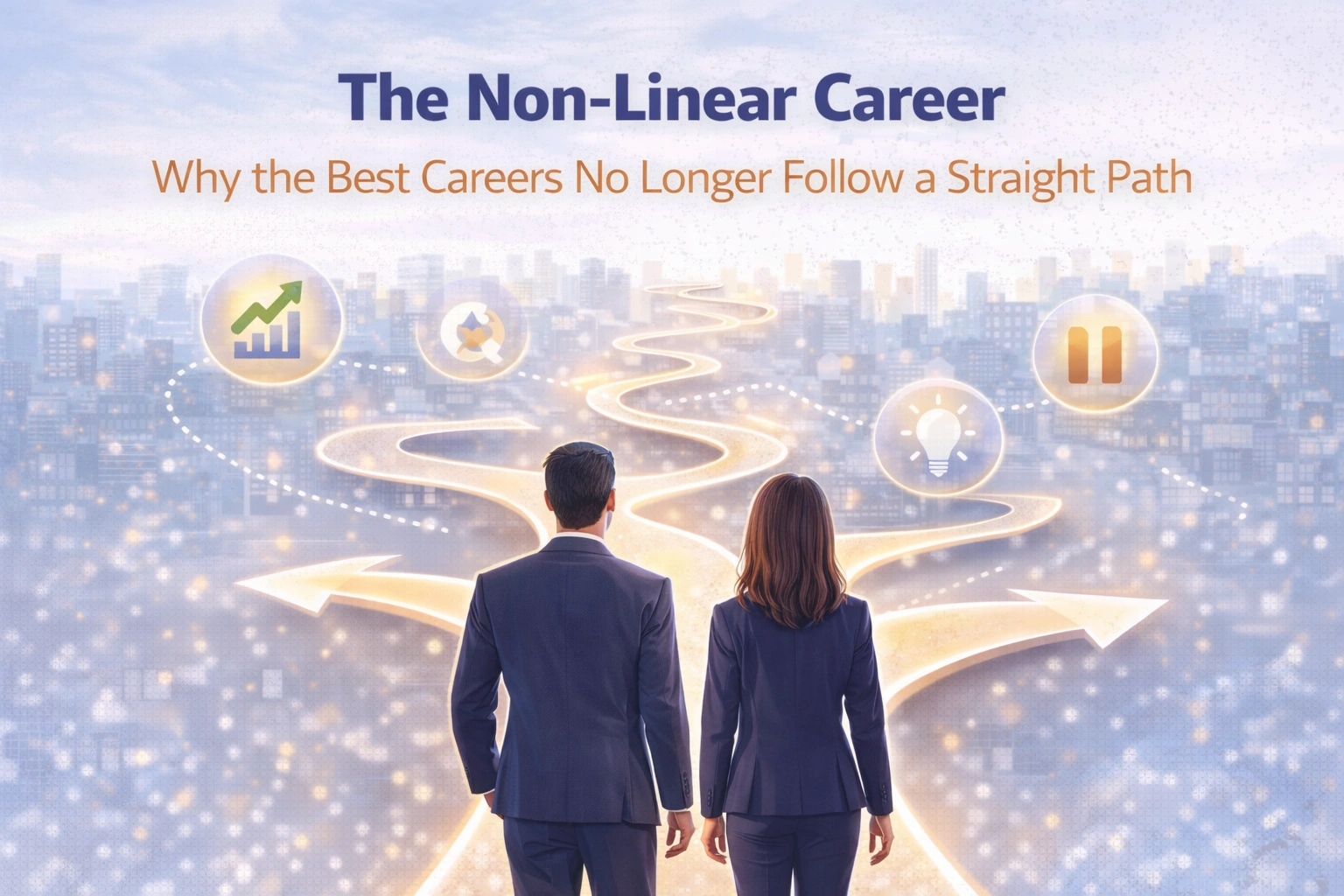
The Non-Linear Career: Why the Best Careers No Longer Follow a Straight Path
How sideways moves, pauses, pivots, and reinvention create stronger, more resilient careers than traditional ladders ever did.
The Career Ladder Was a Story We Were Sold
For most of the twentieth century, career success followed a reassuring story. You entered an organization, performed well, climbed rung by rung, and eventually reached a stable position of authority and security. Titles progressed in a predictable order, and longevity was rewarded with trust.
That model shaped expectations for generations. Parents, teachers, and managers passed it on as common sense. Deviating from the ladder was framed as risk, instability, or failure. Sideways moves looked suspicious. Pauses looked irresponsible. Reinvention looked reckless.
Yet even when this story was dominant, it was never universal. It primarily applied to a narrow slice of professions, industries, and economic conditions. What has changed is not that careers suddenly became chaotic, but that the ladder stopped pretending to be the default.
How the Non-Linear Career Became the Norm
Several forces converged to dismantle the linear career model. Technology cycles shortened dramatically, making skills obsolete faster. Companies became leaner and shorter-lived. Entire industries emerged and declined within a single career span.
AI accelerated this shift. Tasks that once defined roles became automated, while new responsibilities appeared without clear titles. Organizations began valuing adaptability and learning capacity more than tenure.
The result is a labor market where most professionals experience multiple career phases. These phases are not always upward. They include lateral moves, resets, experiments, and sometimes deliberate pauses. Non-linearity is no longer an exception. It is the baseline.
The Four Shapes of Non-Linear Careers
1. Sideways Growth
Sideways moves often look like stagnation on paper. The title changes little, or not at all, while responsibilities shift. Yet sideways growth frequently expands skill breadth, perspective, and influence more than vertical promotions.
Professionals who move laterally into adjacent roles often develop a systems-level understanding that pure specialists lack. Over time, this perspective becomes a competitive advantage.
2. Diagonal Moves
Diagonal moves combine a partial reset with forward momentum. A professional may accept a lower title or smaller scope in a new domain while gaining long-term leverage.
These moves feel risky because they disrupt status. But many leadership trajectories are built on diagonal transitions that trade short-term prestige for long-term optionality.
3. Pauses and Plateaus
Plateaus are often misinterpreted as failure. In reality, they are periods of consolidation. Skills deepen, identity stabilizes, and life priorities recalibrate.
Pauses—whether due to burnout, caregiving, or deliberate sabbaticals—can strengthen careers when used intentionally. The danger lies not in pausing, but in pausing without reflection or a reintegration strategy.
4. Reinvention Loops
Reinvention is not a single event. It is a loop of learning, experimentation, and repositioning. Most successful reinventions build on existing strengths rather than abandoning them entirely.
Professionals who reinvent well treat identity as flexible. They allow themselves to evolve without erasing their past.
Why Non-Linear Careers Build Stronger Career Capital
Non-linear paths expose professionals to varied problems, contexts, and constraints. This diversity strengthens judgment and decision-making, which compound over time.
Career capital grows faster when skills stack across domains. A marketer who understands data, a developer who understands business, or a manager who understands systems gains leverage that linear specialists may lack.
Non-linearity also builds resilience. Professionals who have navigated change before recover faster when disruption occurs again.
The Emotional Cost of Non-Linearity
Despite its advantages, non-linear careers carry emotional weight. Comparison becomes more intense when peers appear to advance steadily. Identity becomes fragile when titles fluctuate.
Imposter syndrome often surfaces during transitions. Even experienced professionals may feel like beginners again, which can be uncomfortable and destabilizing.
Managing these emotions requires reframing progress. Growth is not always visible externally. Much of it happens internally, long before results appear.
Stories of People Who “Fell Behind” and Then Pulled Ahead
A mid-career individual contributor moved sideways into a support-heavy role that peers dismissed as a dead end. Over time, they became the connective tissue between teams. When leadership roles opened, their systems knowledge proved invaluable.
Another professional stepped back after burnout, taking a lower-pressure role to recover. During that period, they rebuilt skills deliberately. Two years later, they re-entered the market with clarity and leverage that had been missing before.
In both cases, apparent regression created future acceleration.
How to Design a Non-Linear Career Intentionally
Intentional non-linearity starts with clarity. Understanding which skills you want to deepen, which experiences you want to gain, and which trade-offs you are willing to accept prevents drift.
Timing matters. Sideways or diagonal moves are most powerful when made before stagnation sets in. Waiting until dissatisfaction becomes acute limits options.
Regular reflection turns non-linearity into strategy rather than chaos.
Resume and Narrative Strategy for Non-Linear Paths
Non-linear careers require strong storytelling. Resumes should emphasize outcomes and skills rather than chronology. Interviews should focus on coherence, not justification.
The goal is not to hide non-linearity, but to frame it as deliberate growth. When transitions are explained through learning and value creation, they become strengths.
The 5-Year Non-Linear Career Map
Traditional five-year plans assume stability. A non-linear map focuses on direction rather than position. It identifies skills to build, experiences to seek, and constraints to manage.
This map evolves annually. Flexibility is built in by design.
Progress Is Not Always Up—Sometimes It’s Deeper
The most enduring careers are not those that rise smoothly, but those that adapt intelligently. Non-linearity allows for depth, resilience, and reinvention.
When progress is measured by learning, judgment, and impact rather than titles alone, careers become more humane and more durable.


